Oddities

  • Advertising’s acceptable face

    KDE is one of the 2 major providers of GUIs and applications for Linux systems (some KDE applications are also now available for Windows too! Ed.).

    It’s currently holding the KDE Akademy 2013, a free, non-commercial event organised by the KDE community, in Bilbao in the Basque Country of Northern Spain from 13th to 19th July.

    The local public transport company has also picked up on this event and is advertising it on its ticket machines; and in 3 languages too!.

    image of Bilbao public transport ticket machine
    Free software advertising – Bilbao

    Would London Underground or the UK’s train operating companies do likewise?

    I’ve written before of my dislike of advertising (posts passim), but advertising for community-based projects – even if those communities are scattered throughout the world – is something for which I’ll make an exception.

  • Bristol Post Balls 2

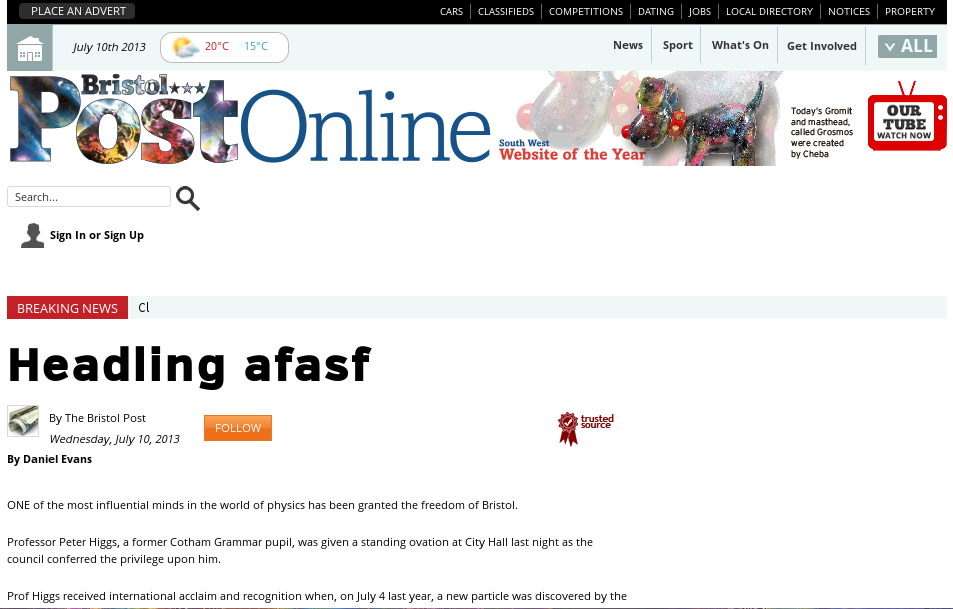
    Below is a screenshot of the story in today’s Bristol Post reporting on Professor Peter Higgs – one of the team that postulated the existence of the particle named after him back in the 1960s – being granted the freedom of the city of Bristol.

    screenshot of Bristol Post article
    Headline quality control in action. Click on image for full size version.

    Professor Higgs is a former pupil of Bristol’s Cotham Grammar School.

    For a local media report of the event that has a proper headline, I recommend Bristol 24/7’s offering.

    Bristol & Avon Family History Society has some interest background information on the history of the Freedom of Bristol and Burgesses, as Freemen (and they were men in medieval times. Ed.) were originally known.

  • Crapita in the dock this morning

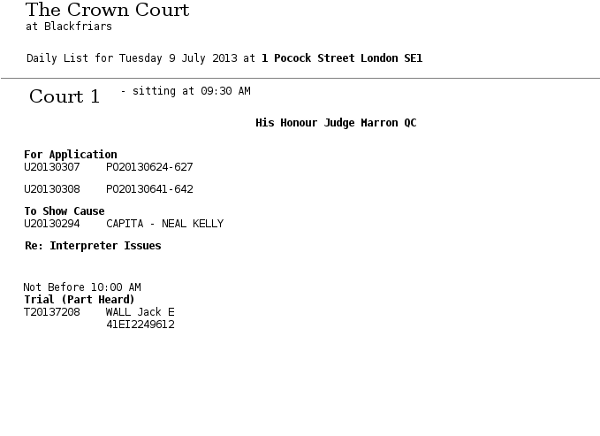
    As the screenshot below shows, Capita, that paragon of outsourcing efficiency, is due to appear at 9.30 at Blackfriars Crown Court in London before His Honour Judge Marron QC regarding “Interpreter Issues”, presumably the failure of Capita Translation & interpreting to fulfil its courts and tribunals interpreting contract with the Ministry of Justice (posts passim).

    screenshot of case listing at Blackfriars Crown Court

    Update: 10.00 am.Peter Shortall has just commented as follows on the RPSI Facebook page:

    Just left Blackfriars CC. It’s being heard in chambers, so I and a lady who had turned up to watch were asked to leave so the judge could talk to the Capita rep privately. So much for transparency!

    Peter also added in an earlier comment that Neal Kelly is Capita’s “relationship manager” who handles “high-level complaints”.

  • Tourism in Lawrence Hill

    “What’s that Gromit, people have been visiting Lawrence Hill to see you in your Lodekka livery, looking like an old-style Bristol Bus Company bus in British racing green?”

    Gromit sculpture in Lawrence Hill
    Gromit attracts a crowd

    “Cracking!”

    Here in BS5, we’re very pleased to have one of the Gromit sculptures placed around the city as part of Gromit Unleashed – a public art exhibition in which giant sculptures of Gromit, decorated by invited artists, have been unleashed on the streets of Bristol and the surrounding area.

    At the end of the art trail, the sculptures will be auctioned to raise funds for Wallace & Gromit’s Grand Appeal, the Bristol Children’s Hospital charity.

  • Bristol and birds of prey

    It’s always a good idea to keep one’s ears open walking around the city – or anywhere for that matter.

    Yesterday lunchtime when crossing St Philips Bridge (below) my ears heard a real treat – a peregrine falcon in the heart of Bristol.

    St Philips Bridge and the former Bristol Tramways power station.
    St Philips Bridge and the former Bristol Tramways power station. Picture courtesy of Wikimedia Commons

    peregrine falcon image
    Peregrine falcon
    Following the sound, I spotted the peregrine perched on a ledge near the top of the old Bristol Tramways power station, the building whose end is covered in scaffolding in the picture.

    I’ve seen peregrines before near Bristol, particularly down the Avon Gorge, where I’ve spotted them nesting in the Gorge’s old quarries, but never before in the heart of the city.

    Naturally, I was quite excited by this and asked Bristol’s Twitter users how unusual this was. After a couple of hours, I received a reply from naturalist and broadcaster Ed Drewitt, who informed me there was a “family of 3 chicks around Cabot Circus way” (they might help keep the city centre’s gull and feral pigeon population under control. Ed.).

    Around my home patch of Easton I have over the years seen both sparrowhawks and kestrels, whilst moving further afield the patchwork of open grassland and woodland on Purdown and Stoke Park is ideal buzzard territory.

    Finally, there’s one bird of prey I believe I’d heard that I’d really love someone else to corroborate. Returning home some years ago, I could have sworn I heard a tawny owl hooting in the vicinity of the railway embankment between Stapleton Road and Lawrence Hill railway stations. If anyone else has heard hooting there too, I’ll know I wasn’t imagining things. 🙂

  • French stay connected on holiday

    Nearly one in two French citizens takes a computer on holiday to connect to the internet, reports Le Monde Informatique.

    A survey has revealed that 47.2% of the French may take a computer on holiday this summer, with a peak of 60% in the 18-24 years old group. A majority of them plan to use the computer for an average half an hour a day (46.1% between 30 minutes and 1 hour; 17.3% more than one hour).

    Once connected, 87.5% of holidaymakers will use their computer to surf the internet, 57.6% for leisure (watching films or listening to music), 37.4% for saving or retouching their photographs and 19.8% for work.

    Although 91.2% of holidaymakers will be connecting from where they are staying (hotel, rented accommodation, camp site), 29.8% also want to make use of places offering wifi connections, 11.7% for surfing while travelling and 4.2% are even going to be brave enough to use their computer on the beach. A majority of them (64.3%) also complain regularly of the lack of wifi or its poor quality.

    Even though the majority of holidaymakers (71.9%) give priority to relaxing during summer, spending time in front of a computer or another device has now become a priority form almost one in 10 French citizens (9.3%).

    This survey was conducted by Easy Panel for Crucial.fr via the internet from 23rd to 26th April 2013 using a sample of 1,015 people owning a computer and representative of the French population.

  • Inflation in North Somerset

    The phrase “to spend a penny”, meaning to use a public lavatory, has its origins in the use of coin-operated locks on public toilets in the UK. When these were first introduced, the fee for use was normally one penny (1d); and it stayed at that level for decades, well into the second half of the twentieth century.

    However, the cost of being caught short and having to use a public lavatory has undergone a massive inflationary rise if a report in today’s Bristol Post is to be believed.

    picture of 10 shilling note

    Pictured above is an old English bank note with a face value of 10 shillings; that’s equivalent to 240 pence.

    The Bristol Post report states that people could be charged up to 50p (that’s ten shillings in old money. Ed.) to spend a penny in a new block of town centre toilets in Portishead, which could cost up to £40,000 to build.

    The Post quotes Portishead Town Council Clerk Jo Duffy as follows on the likely cost of spending a penny:

    There would be a charge levied for using the toilets, which could be up to 50 pence per visit. However the town council is keen to keep the charge at a lower level of around 20 pence if possible.

    Even 20 pence for a pee is extortionate, in my opinion.

    This blog has covered the peculiarities of life in North Somerset before now (posts passim) and at least one person leaving a comment on the Post report feels relieved he’s not a resident:

    Every day I wake up and thank the Lord that I don’t live in North Somerset.

  • Mayflower in the Underfall

    The Mayflower is a steam tug preserved by Bristol Museums Galleries & Archives. She is based in the City Docks outside the M Shed. She is the oldest Bristol-built ship still afloat and is believed to be the oldest surviving tug in the world.

    She was launched on 18th May 1861, cost £1,000 and was built to work on the Gloucester and Sharpness Canal and the River Severn.

    This week she’s not afloat at all, but high and dry on the patent slipway of the Underfall Yard undergoing some maintenance and is due to remain there for the next week, as I gathered on Friday evening.

    image of Mayflower out of the water
    Mayflower out of the water
  • The Linux Lord’s Prayer

    Tux - the Linux kernel mascot
    Tux – the Linux kernel mascot
    One item I missed from my list of highs on last week’s Barncamp post was hearing Naomi from Sheffield recite the Linux Lord’s Prayer she’d devised many years earlier; I first heard Naomi recite it round the campfire in June 2010. This year at Barncamp, Naomi performed it on stage during the Open Mic session on Saturday night.

    The prayer is reproduced below for those you have yet to come across it. I hope you enjoy it.

    Our father, who art in /sbin,
    init is thy name.
    Thy PID is 1;
    Thy children run
    In user space as they do in kernel.
    Give us this day our daily RAM
    And forgive us our interrupts
    As we are nice to those who interrupt us.
    Lead us not into uncaught exception
    And deliver us from SIGKILL
    For thine is the system
    And thou art the saviour
    For ever and ever – until we upgrade yer!

    In addition, Andreas Pothe has translated Naomi’s original prayer into German:

    Vater Unser, der Du da bist in /sbin,
    init ist Dein Name.
    Deine PID ist 1,
    Deine Kinder laufen
    Im Benutzermodus wie auch im Kernel.
    Unser tägliches RAM gib uns heute
    Und vergib uns unsere Unterbrechungen
    Wie auch wir vergeben unseren Unterbrechern.
    Und fĂĽhre uns nicht in unbehandelte Ausnahmen
    Und erlöse uns von dem SIGKILL
    Denn Dein ist das System
    Und die Kraft und die Herrlichkeit
    In Ewigkeit – Bis wir Dich updaten!

  • Fedora caught in language trap

    Fedora Pi remix logoFedora, the community spin-off of Red Hat Linux, has announced the release of Pidora – a special remix of Fedora for the Raspberry Pi, as follows:

    Pidora 18 (Raspberry Pi Fedora Remix) Release

    We’re excited to announce the release of Pidora 18 – an optimized Fedora Remix for the Raspberry Pi. It is based on a brand new build of Fedora for the ARMv6 architecture with greater speed and includes packages from the Fedora 18 package set.

    * * *

    There are some interesting new features we’d like to highlight:

    • Almost all of the Fedora 18 package set available via yum (thousands of packages were built from the official Fedora repository and made available online)
    • Compiled specifically to take advantage of the hardware already built into the Raspberry Pi
    • Graphical firstboot configuration (with additional modules specifically made for the Raspberry Pi)
    • Compact initial image size (for fast downloads) and auto-resize (for maximum storage afterwards)
    • Auto swap creation available to allow for larger memory usage
    • C, Python, & Perl programming languages available & included in the SD card image
    • Initial release of headless mode can be used with setups lacking a monitor or display
    • IP address information can be read over the speakers and flashed with the LED light
    • For graphical operation, Gedit text editor can be used with plugins (python console, file manager, syntax highlighting) to serve as a mini-graphical IDE
    • For console operation, easy-to-use text editors are included (nled, nano, vi) plus Midnight Commander for file management
    • Includes libraries capable of supporting external hardware such as motors and robotics (via GPIO, I2C, SPI)

    Unfortunately for Fedora, Pidora has a rather embarrassing meaning to some: in Russian, “pidora” is a derogatory word for a male homosexual. As a consequence, the following announcement has been posted on the Pidora website:

    It has come to our attention that the Pidora name bears an unfortunate similarity to another word in Russian, and this has offended some community members and amused others.

    Please accept our apologies for any offence caused. Our goal was to simply associate “Pi” (from Raspberry Pi) and “Fedora” (from the Fedora Project).

    We are actively seeking a broadly-acceptable alternative Russian name in consultation with some community members, and will post more information shortly.

Posts navigation