Correlation/causation latest
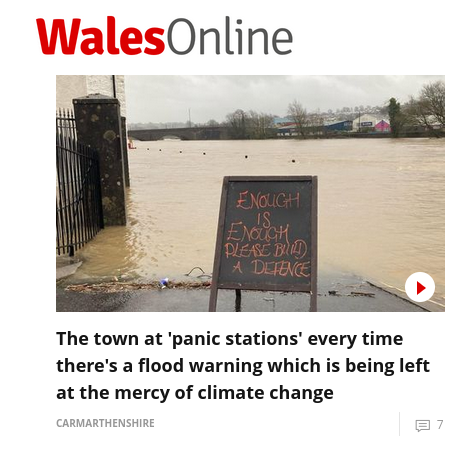
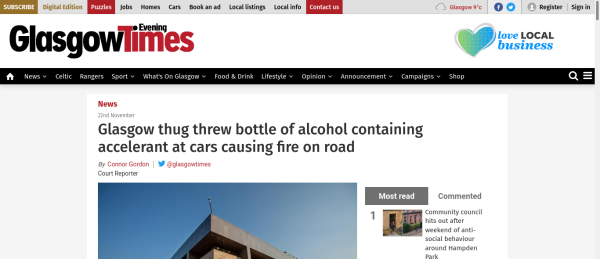
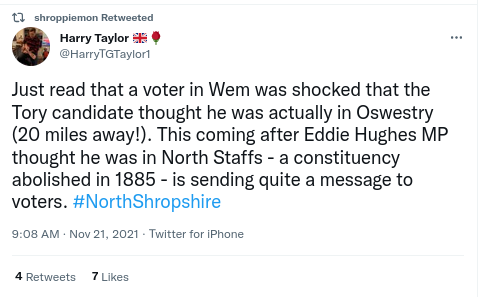
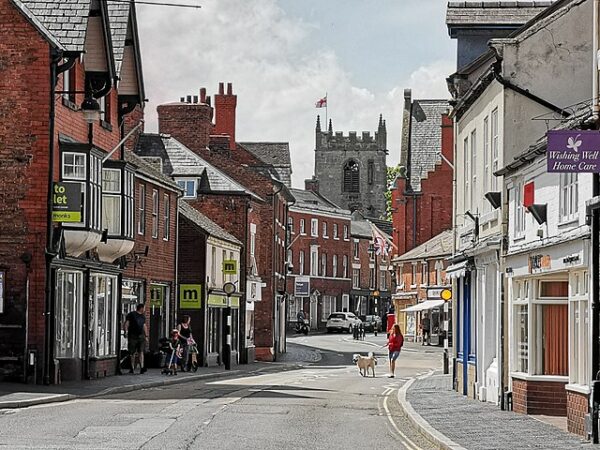
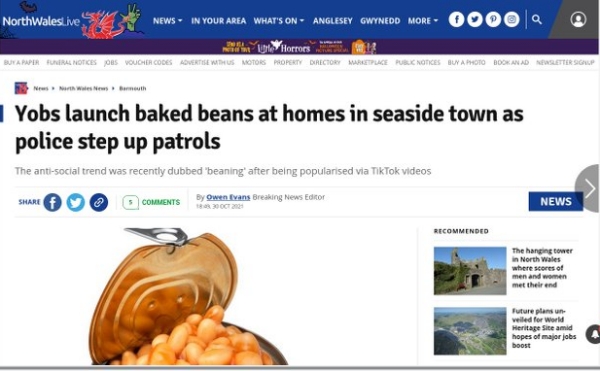
More lazy, confusing headline writing from a Reach plc title, in this instance today’s North Wales live website.
To paraphrase a well-known advertising slogan, Beanz meanz crimez, North Wales Live? 😉
More lazy, confusing headline writing from a Reach plc title, in this instance today’s North Wales live website.
To paraphrase a well-known advertising slogan, Beanz meanz crimez, North Wales Live? 😉
In the small hours of Friday morning, news came in that Facebook Inc. is to change its name to Meta, allegedly better to “encompass” what it does as it expands from social media to other sectors such as virtual reality.
Meta, from the Greek μετα-, meta-, meaning “after” or “beyond“, is a prefix meaning more comprehensive or transcending.
Whether the rebrand will involve the more dubious of Facebook’s more comprehensive or transcending business practices being extended to those new sectors remains to be seen.
Facebook was founded in February 2004 by Harvard student Mark Zuckerberg. Not long afterwards, the controversies and abuse of users started. As The Register recalled in 2010, the then 19 year-old Zuckerberg called his first few thousand users “dumb f*cks” in a private conversation with a friend.
However, even that early sign of contempt did not prevent Zuckerberg’s social media infant growing into an obese behemoth of the social media sector, with a current user (i.e. product. Ed.) base of 2.85 billion people.
Perhaps Zuckerberg is secretly delighted there are so many dumb people in the world. They’ve been paying his bills for more than one and a half decades, after all.
After those early days, Facebook’s user base grew, as did the propensity for abuse, culminating in the Cambridge Analytica data scandal. Cambridge Analytica was established in 2013 as a subsidiary of the private intelligence company and self-described “global election management agency” SCL Group by 3 long-serving SCL executives. The company offices in London, New York City and Washington, DC. Cambridge Analytica was implicated in affecting the results of the 2016 US presidential campaign, where data it hoovered up from Facebook users was used to build psychographic profiles, determining users’ personality traits based on their Facebook activity. These profiles were then used for micro-targeting voters displaying customised advertisements on various online platforms. The key point of this activity was to identify those who might be enticed to vote for Trump or be discouraged to vote for their opponent. In addition, Cambridge Analytica was allegedly hired as a consultant company for Leave.EU and the UK Independence Party during 2016 as an effort to convince people to vote in favour of the UK leaving the European Union in David Cameron’s amateurish EU membership referendum. However, the UK Information Commissioner’s official investigation found that Cambridge Analytica was not involved “beyond some initial enquiries” and the regulator did not identify any “significant breaches” of data protection legislation or privacy or marketing regulations “which met the threshold for formal regulatory action“. Cambridge Analytica cased operations in 2018 following the revelations of its privacy-busting operations, although firms related to both Cambridge Analytica and its parent firm SCL still exist.
Zuckerberg subsequently apologised for Facebook’s involvement with Cambridge Analytica, calling it an “issue“, a “mistake” and a “breach of trust“, as well as pledging not to let such abuse occur again.
Nevertheless, the abuse of users didn’t stop and have continued right up to the present.
The latest revelations come ex-employee Frances Haugen, who was employed by Facebook as a data scientist, leaked documents revealing that the company placed “profits over safety“. Since her revelations, Ms. Haugen has given evidence to a US Senate sub-committee and testified in person to a UK parliamentary committee scrutinising the online safety bill.
Reporting on the name change, The Register noted beneath its headline that Zuckerberg’s social network has “Meta-stasized“. Leaving aside El Reg’s overt reference to the former secret police of the so-called German Democratic Republic, metastasis is defined as a change of position, state, or form. The primary use of metastasis today is in medicine where it defines the development of secondary malignant growths at a distance from a primary site of cancer.
Finally, as a further dampener on the rebrand’s distraction value, a report in today’s Guardian reveals that Meta translates as dead in Hebrew.
Have fun in Zuck’s metaverse, y’all! 😀
Your ‘umble scribe is not a listener to Rupert Murdoch’s TalkRadio channel, being as it is top-heavy with right-wing presenters and commentators.
Furthermore, its audience compared to other national broadcasters is tiny, with Rajar figures revealing an average national number of listeners of 433,000, i.e. less than the current estimated population of Bristol.
One of those right-wing presenters had a bad day at the studio yesterday.
Step forward one Archibald Michael Graham, otherwise know as ‘Iron’ Mike, former editor of the Scottish edition of the Daily Mirror and former assistant editor of the Daily Brexit (which some still call the Express. Ed.).
Yesterday he’d invited Insulate Britain spokesperson Cameron Ford, onto the TalkRadio breakfast show, where he is currently deputising for the dreadful Julia Hartley-Brewer, ostensibly to discuss Insulate Britain’s latest protest action, but more likely so that Ford could give him a good verbal kicking for the entertainment of the station’s none too large audience.
However, matters did not progress entirely to plan, leaving Iron Mike’s carapace pitted with rust as he ended up displaying his own stupidity, which has now gone viral around the English-speaking world.
Graham’s stupidity was so egregious that the hashtag #ConcreteMike is trending on Twitter today.
The interview, which lasted less than one minute in total, starts with no style at all. Graham launches straight into an ad hominem attack on his guest – a carpenter by trade – claiming that wood is not a sustainable product, before trying to assert that concrete is a sustainable product, before being politely corrected. There then follow a period of silence before Graham ends the interview thinking he’s embarrassed his guest, whilst not having the nous to realise he has opened his mouth and inserted his foot up to the ankle, as per the video clip below.
On 11th October 1721 Bristol-born slave trader, insider share dealer, financier, religious bigot and former Tory MP for the city Edward Colston died at his home in Mortlake, then in Surrey, now in south west London.
In his will Eddie the Slaver left £50,000 for good causes in the city of Bristol, provided not one penny was spent on Catholics or non-conformists. This bequest formed the basis of the charitable works carried out to this day by the city’s secretive and elitist Society of Merchant Venturers.
In the late 19th century the Victorian fathers around the country – and they were all male and rich – were looking round for examples of former local worthies to commemorate. Bristol’s business and civic elite were no different in this respect from their counterparts elsewhere and chose this immoral man with blood on his hands for this philanthropy, even though we would now regard Colston’s wealth as blood money, i.e obtained at the expense of the life of others.
As memorials to his beneficence, a statue was erected to Colston in the city centre in 1895, whilst one of the city’s main entertainment venues was named after him, along with two city centre streets – Colston Street and Colston Avenue.
After the Colston statue was toppled last summer and then taken for an unscheduled bath in the city docks, the city council announced that both Colston Street and Colston Avenue would revert to the names they had for centuries – Steep Street and St. Augustine’s Back (or Bank) respectively – before they removed from the city’s street plan by the Cult of Colston.
In the east Bristol district of Easton, which underwent major development and expansion in the late 19th century, one of the new streets was named Colston Road in pursuit of this devotion to his cult. Despite years of clamour by Easton residents for the area’s slaver trader memorial street to be renamed, nothing happened (despite the road in question being home to one serving and one former city councillor. Ed.),so locals have now taken matters into their own hands.

Your ‘umble scribe has been in touch with serving Easton ward councillor Barry Parsons about the inordinate amount of time Bristol City Council is taking to rename Slaver’s Road BS5.
Barry has been in touch with the council’s Street Naming and Numbering Officer, who is responsible for the naming and renaming of streets within Bristol’s boundaries. The Council’s street renaming policy requires full written consent from the owners of every property affected for a change of name. If such consent is forthcoming, the council the initiates a formal notice period for the name change where notices are erected on the street and wider objections can be made to the courts.
Why are efforts to rename Easton’s Slaver’s Road taking so long? The answer could lie in the fact that the road has 130 residential properties, many of them in the hands of absentee landlords, so obtaining written consent from so many disparate persons is an onerous task. However, your correspondent understands that efforts are underway, probably with that lack of alacrity so typical of BBC, to lower the threshold to 80 per cent.
Yesterday your correspondent took a break from the inner city and headed by rail to the North Somerset Coast at Weston-super-Mare.
Plenty of good, fresh air and healthy exercise was had, with my walking from the railway station to the far end of Weston bay at Uphill where the River Axe empties into the Bristol Channel between Brean Down and the semi-tidal Black Rock, as shown below.

The eastern limit of the Bristol Channel is defined by the International Hydrographic Organization as that area between two lines between Sand Point in Somerset and Lavernock Point and the western limit a line between Hartland Point in Devon and St. Govan’s Head. Upstream of the eastern limits, the body water is the Severn Estuary, whilst westwards of the western limit is defined as the Celtic Sea.

However, the phrase Bristol Channel has not always been used to characterise this area of water.
Until Tudor times the Bristol Channel was commonly known as the Severn Sea. Indeed, it is still known as this in both Welsh: Môr Hafren and Cornish: Mor Havren, whilst on Jacob Millerd’s 1673 map of Bristol shows the Severn Estuary in the Latin, Sabrina Fluvius, as depicted below.

One of the phrases guaranteed to dismay every regular user of Britain’s chaotic and overpriced railway network is rail replacement service. This involves taking the scheduled service off the rails (usually for engineering works at busy holiday periods when everyone either wants to get away and/or visit friends and loved ones. Ed.) and substituting the rolling stock with buses, with the inevitable increased journey times and a reduction in passenger comfort.
However, these rail replacement services do not serve Stapleton Road railway station, where the sign shown below is affixed to the Frome viaduct wing wall on the station approach.

As the station is under the management of First Great Western, an alleged train operating company, you ‘umble scribe assumes it was their staff who designed, wrote and approved the final signage.
For any passing First Great Western signage design drones, here’s a wee tip: a spellchecker now comes as a standard feature of all popular office productivity suites. 😀
From Monday’s Bristol Post.
Is this:
The Murdoch Sun has long had a reputation for making up stories, such as the infamous The Truth front page which accused Liverpool fans of misbehaviour and criminality at Hillsborough in 1989 when 97 Liverpool football fans lost their lives in an incident which a later inquest ruled to have involved unlawful killing.
That front page untruth resulted in a boycott of Rupert’s rag by the city of Liverpool that continues to this day.
However, not content with upsetting a city for over 3 decades with a made-up story, Murdoch’s apology for a newspaper has now started on a more ambitious project – making up a new language akin to English, starting with changing the past tense of the verb to fly from a strong verb conjugation to a weak verb one.
The headline has since been corrected following mockery on social media to the effect that it’s now written by 10 year-olds.
Is there no start to the talent of those members of its staff that the title insists it employs as journalists?
How many times have you heard or read the phrase “We take (insert_topic_here) very seriously…” in a newspaper or broadcast media news item?
Today’s Guardian website includes a report with not just one but two organisations – HS2 and the Environment Agency – claiming precisely that they take matters within their respective bailiwicks “incredibly seriously” (HS2) and “very seriously” (Environment Agency).
This “seriously” – whether qualified or not – appears to be part of the hackneyed stock reply to the unearthing of errors or shortcomings that the bodies involved would have preferred not to have come to light and seems to your ‘umble scribes mind to be shorthand for “we’ve been caught out“.
Another way of describing them is weasel words, i.e. something that someone says either to avoid answering a question clearly or to make someone believe something that is not true. In other words lies and/or hypocrisy are brought into play to save the reputation and embarrassment of the organisation involved and its senior management.
The Guardian’s story appears to be a classic example of the modern (mis)use of the adverb seriously. However, your correspondent does at the same time note that neither of the organisations involved resorted to that other stock phrase frequently wheeled out when they’ve been found wanting, i.e.: “We have robust measures in place…“. But let’s leave the deceit inherent in the use of robust for another time.
Finally, if HS2 is sincere, the use of the adverb “incredibly also merits examination. Its dictionary definition is “difficult to believe“, so in effect what HS2’s was actually saying is that it is hard to believe the organisation takes the matter seriously at all. 😀
Welsh schoolteacher Stephen Mason has set up a YouTube channel called So You’ve Moved to Wales (SYMTW) specifically for non-Welsh speaking schoolchildren moving to a Welsh school and having to catch up on Welsh language studies, Nation Cymru reports.
Mr Mason works at Queen Elizabeth High School in Carmarthen and has 25 years’ service at the chalkface.
Explaining his motive for setting up the SYMTW channel, Mr Mason told the paper:
Moving home and changing schools when you are a teenager is a stressful time. A new country, a new school and a new language can easily become associated with an unhappy or stressful life episode. I therefore decided to make a series of videos for Welsh teachers to share with latecomers to their subject that would help them settle into their new surroundings more easily.
The first of Mr Mason’s videos is embedded below.