Language

  • Bristol Post Balls – beefing about faggots

    Today the Bristol Post has been occupied with faggots. It all started when Facebook, that bastion of free speech, banned the use of the word faggot as offensive. Apparently they’ve never heard of this traditional item of English cuisine over the pond, where faggot is a term of abuse for homosexuals.

    As a result, Mr Brain’s – a producer of culinary products resembling faggots that started life in the Bristol area – has started a campaign to fight against Facebook’s ban, which is duly being reported by the Post.

    In addition, the Post also informed its readers what faggots are. Any similarity between the Post’s article and the introduction to Wikipedia’s faggots article is presumably purely coincidental.

    However, the Post hasn’t finished with faggots yet; it also tells its by now slavering readers how to make faggots. After having stated that faggots are made from pork, the Post drops a real clanger on this report, illustrating it with a photograph of a butcher (so far, so good. Ed.) posing with a joint of beef (D’oh! Ed.), as evidenced by the screenshot below.

    Bristol Post screenshot

  • Capita: still lost in translation?

    The Ministry of Justice has released statistics for the use of language services in courts and tribunals for the second quarter of 2013 (PDF).

    If Capita Translation & Interpreting still has a 98% performance target for filling all requests for language services for courts and tribunals, then the fact it is only filled 92% of requests in the quarter under review – as stated by the report – means they are still failing to fulfil the terms of their contract with the MoJ.

    Furthermore, the report gives figures for “off-contract” language service bookings for the first time.

    “Off contract” bookings are requests for translation and interpretation [sic] services made outside the Capita TI contract. Bookings for the service are made directly by the courts and tribunals – that is, not through the language service booking portal.

    In Q2 2013 – the first quarter for which data is held centrally – a total of 2,929 off contract bookings were made by criminal courts, civil & family courts and tribunals. This accounted for just under 7% of all bookings made for languages services in that period.

    Just over half (51%) of these bookings were made by tribunals, with a further 48% made by criminal courts.

    This blog will be keeping a close eye on the figures for “off contract” bookings in future. Any increase over subsequent quarters will mean that Capita T&I are living up to their parent company’s well-deserved nickname: Crapita.

  • Wanted: English interpreters in London

    The title is true and it’s a genuine item straight from the news you couldn’t make up department: Capita Translation & Interpeting, the outfit responsible for making an utter mess of the courts and tribunals interpreting contract with the Ministry of Justice (posts passim) is seeking English interpreters for assignments in the London area.

    Yes, it does sound amazing, but below is a screenshot of a page from Capita T&I’s website, captured today at 4.45 pm. English is the fifth item down the list.

    screenshot of Capita T&I web page
    English speakers wanted in London? The mind boggles.

    Do you have any ideas why Crapita should need English interpreters in the capital of the country where the language originated? Put them in the comments below. 🙂

    Hat tip: RPSI Linguist Lounge

  • Calibre 1.7 released

    Version 1.7 of Calibre, the cross-platform e-book reader and management software, was released on 18th October, Softpedia reports.

    Calibre’s features include:

    • Library management;
    • E-book conversion;
    • Syncing to e-book reader devices;
    • Downloading news from the web and converting it into e-book form;
    • Comprehensive e-book viewer;
    • Content server for online access to your book collection.
    image of calibre interface
    Calibre running on the KDE desktop under Linux

    A complete list of changes since the last version release can be found in Calibre’s release announcement.

    The new version is available for download for Linux, Mac OSX and Windows.

  • Capita T&I attempts sub-contracting to fulfil MoJ contract

    Sub-contracting is quite common in the language business. Every week or two I’ll do a job for an agency that’s been placed with them by another (usually larger) agency.

    This seems to go all the way to the top and is not confined to translation: interpreting jobs also get sub-contracted.

    As regards interpreting, RPSI Linguist Lounge last week published a post written by Oskar offering evidence that Capita Translation & Interpreting are also playing the same game to attempt to meet their contractual obligations to the Ministry of Justice under the framework agreement for interpreting services for courts and tribunals. Oskar’s words are reproduced in full below.

    I did some private work for solicitors last week at Uxbridge Magistrates Court. I spoke to a Romanian interpreter from thebigword. It seems that C-ta are unable to fulfil their contractual obligations, so courts are trying to call other agencies. On several occasions I was told by interpreters working outside of London that in several counties – Cambs, Notts, Northants, courts revert to calling other agencies or small/local agencies were approached by C-ta and asked to subcontract their interpreters in several languages. With regard to their so-called tier system, I have been advised that for NHS bookings they send people classified as Tier 4, what’s next then: a proverbial cleaning lady, mind you, these ladies are better paid and promptly as well. Who is behind upholding this unprofitable, undermanned and badly managed contract? Why aren’t SOCA or other LEA investigating it already?

  • Bristol Post Balls – an embarrassing vowel movement in public

    Crosby Stills & NashThere’s hardly a day goes by without the Bristol Post screwing up somewhere.

    Today it features a glowing review of veteran US three part vocal harmony and guitar group Crosby, Stills & Nash.

    However, at one point the language is not so much glowing as glaringly wrong when Mr Harnell trips over a near homophone:

    Despite hoovering up the Gross National Product of Columbia in his darkest days, David Crosby’s voice remains a thing of wonder.

    Columbia? The female personification of the United States of America?

    I think the reviewer had got his vowels muddled and actually meant Colombia, a South American country famous for the supply of a variety of white nasal decongestant allegedly enjoyed at one time by Mr Crosby.

  • PI4J survey

    PI4J logoProfessional Interpreters for Justice (PI4J), the umbrella group for interpreter organisations, has been campaigning since 2011 against the Ministry of Justice’s Framework Agreement and outsourcing of criminal justice interpreting to Capita Translation & Interpreting (formerly Applied Language Solutions/ALS).

    PI4J, in conjunction with Involvis, has just launched an online survey for interpreters (its fourth. Ed.) and, as well as hearing from interpreters about their current situation and thoughts about the future, also wants to hear interpreters’ views about PI4J and how they see its role. Should PI4J continue and if so, what is its primary role?

    The Capita T&I contract ends in October 2016 but re-tendering will begin much sooner and PI4J’s focus needs to be on what happens next.

    The survey will be open for responses until 10pm on Sunday 20th October 2013.

    Take the survey.

  • An apposite typo?

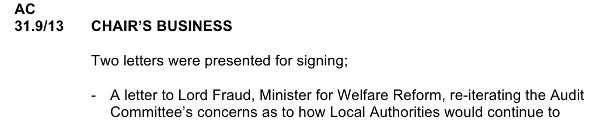
    I’m not a regular reader of the minutes of meetings of Bristol City Council’s Audit Committee. However, there’s an absolute corker of a typographical error on page 3 of the draft minutes of its 24th September 2013 meeting (PDF).

    image of BCC audit committee minutes

    Will anyone down at the Counts Louse (as real Bristolians call or) or City Hall (as the Mayor has renamed it) be eagle-eyed enough to notice?

    Under no circumstances Lord Fraud should not be confused with Lord Freud, a Conservative peer who only pretends to be a Parliamentary Under-Secretary at the Department for Work and Pensions with responsibility for welfare reform. 😉

  • Guardian latest media outlet to confuse translators and interpreters

    The Guardian, immortalised in Private Eye as The Grauniad for its error-prone typographical propensities, now reveals its errors are not restricted to orthography.

    The home page of today’s online edition has a link to an item on machine translation and online translation tools. The perils of machine translation is a topic which has also featured on this blog (posts passim).

    However, the link to the report is illustrated by an image depicting interpreters at work, as the following screenshot shows.

    screenshot from Guardian website

    This means The Guardian is now the latest media outlet in the UK willing to employ illiterates who can’t tell interpreters from translators along with the likes of the BBC (posts passim) and the Bristol Post (posts passim).

    This blog has a handy illustrated guide on the difference between these two sorts of linguists should employees of any of the above organisations need enlightenment.

Posts navigation