Tech

  • Goodbye to OpenOffice?

    When your ‘umble scribe first started using the GNU/Linux operating system over a decade ago, the default office suite for most Linux distributions was OpenOffice.

    However, it now looks as if OpenOffice just could be heading towards the software graveyard if other members of the development team concur with an email from the chairman of the OpenOffice Project Management Committee, Dennis Hamilton, as reported by LWN.net.

    OpenOffice menu
    OpenOffice 4.0. The end of the line?

    A long history

    To find the earliest origins of OpenOffice, one has to go back nearly 30 years to 1985 and an early office suite called Star Office. The timeline below shows the genesis of OpenOffice and other packages from StarOffice 1.0. StarOffice itself survived as a proprietary software package until discontinued by Oracle in 2011.

    timeline showing Open Office and other derivatives of Star Office
    Timeline showing Open Office and other derivatives of StarOffice. Click on image for the full-sized version. Timeline courtesy of Wikimedia Commons

    To understand the various twists in the OpenOffice story, one also needs to know that StarDivision, the creator of StarOffice, was acquired by Sun Microsystems in 1999, whilst Sun Microsystems was in its turn taken over by Oracle Corporation in 2010.

    After the 1999 takeover of StarDivision, Sun released a free and open source version of StarOffice as OpenOffice.org under both GNU LGPL and the SISSL (Sun Industry Standards Source License). OpenOffice.org supported proprietary Microsoft Office file formats (though not always perfectly), was available on many platforms (Linux, Microsoft Windows, Mac OS X and Solaris) and became widely used in the open source community. OpenOffice.org had native support for the OpenDocument format (ODF).

    Following Oracle’s takeover of Sun Microsystems in 2010, some members of the OpenOffice.org project became worried about its future with Oracle. As a consequence they formed The Document Foundation and created the LibreOffice fork. The LibreOffice brand was hoped to be provisional, as Oracle had been invited to join The Document Foundation and donate the OpenOffice.org brand to the foundation.

    Oracle’s response was to demand that all members of the OpenOffice.org Community Council involved with The Document Foundation step down from the Council, citing a conflict of interest. This prompted many community members decided to leave for LibreOffice, which already had the support of Red Hat, Novell, Google and Canonical. LibreOffice produced its first release in January 2011.

    In June 2011 Oracle donated the OpenOffice.org trade marks and source code to the Apache Software Foundation, which Apache then re-licensed under its own open source licence. IBM donated the Lotus Symphony codebase to the Apache Software Foundation in 2012. The developer pool for the Apache project was seeded by IBM employees and the Symphony codebase was incorporated into Apache OpenOffice.

    However, Apache OpenOffice has not flourished, whilst LibreOffice has gone from strength to strength, OpenOffice has languished. LibreOffice releases updates every few months, whereas the last major update to Apache OpenOffice was in September 2015. Furthermore, a hotfix released at the end of August to remedy a memory problem has still not been announced by the project on its home page.

    Apache applies pressure

    In the meantime the Apache Software Foundation has been applying increasing pressure due to security concerns and has since demanded monthly reports (instead of the previous quarterly reports. Ed.) as to how problems can be solved.

    In his email Hamilton describes in detail what the retirement of the OpenOffice project could look like and what consequences will be involved for the source code, downloads, website, mailing lists and other matters. For the time being Hamilton only wants to start a discussion. A decision to end the OpenOffice project has still not been taken, although it is already being suggested that the project should consider donating the OpenOffice trade mark registration to the LibreOffice project.

  • Post exclusive! Soccer slump leads to bank branch closures

    A strange phenomenon is occurring in Bristol: people not playing football is resulting in the closure of bank branches in the city.

    The source of this curious news is the ever (un)reliable Bristol Post, which yesterday carried a story headlined: “Two HSBC banks to shut in Bristol following slump in customers“.

    The relevant section is shown in the following screenshot*.

    relevant sentence reads There has been a 40 per cent reduction in football in just five years across all of HSBC's branches

    Either football is vital to the survival of HSBC bank branches or there’s a typographical error in the third sentence.

    To help readers decide which of the two above alternatives is correct, your correspondent has not noticed that the floors of HSBC bank branches are marked out with white lines to resemble football pitches.

    As a final thought and a bit of idle speculation, are more errors creeping in to news reports appearing online due to modern “journalists” working with predictive text options switched on?

    * = The article’s copy has since been amended with “footfall” replacing “football” in the third paragraph.

  • TDF & FSFE strengthen ties

    TDF logoIt’s been announced today that the Free Software Foundation Europe (FSFE) is joining the Advisory Board of The Document Foundation, the body behind the very successful free and open source LibreOffice productivity suite. At the same time, The Document Foundation is becoming an associate of the FSFE.

    FSFE logoThe FSFE’s aim is to help people control technology instead technology controlling them. However, this is a goal which no single organisation can achieve on its own. FSFE associated organisations are bodies that share the FSFE’s vision and support the foundation and free software in general by:
    • encouraging people to use and develop free software;
    • helping organisations understand how free software contributes to freedom, transparency and self-determination; and
    • removing barriers to free software adoption.

    With this mutual expression of support, both organisations mutually strengthen each other in their efforts to keep the general public in the technological driver seat. While the FSFE embodies the principles of the community movement working for the adoption of free software by companies, public sectors organisations and individuals, The Document Foundation turns principles and ethics into actual products, putting a first class, fully-featured, but completely free productivity suite in the hands of users.

    “We are happy to welcome the Free Software Foundation Europe as a member of our Advisory Board. Together, we will be able to further develop the adoption of Free Software in Europe, amongst public administrations and enterprises”, said Eike Rathke, a Director of The Document Foundation.

    “We believe it is important to join forces with all the organisations active in Free Software around Europe,” said Matthias Kirschner, President of the Free Software Foundation Europe, “and work together to reach our common goals. With our associated organisations we want to show that we are a strong and cohesive movement, and we work to achieve common objectives. To do this, we exchange ideas, coordinate efforts, motivate each other, and find opportunities to work together on specific projects. This is the case with The Document Foundation, steward of one of the most successful Free Software projects: LibreOffice”.

    Several members of The Document Foundation will be attending the FSFE Summit 2016 in Berlin from 2nd to 4th September to celebrate the FSFE’s 15th anniversary (posts passim).

  • Trip Advisor under fire over Welsh reviews

    Trip Advisor, the world’s largest travel site, is under fire from Welsh speakers for refusing to publish reviews in Welsh, the Daily Post reports.

    Welsh flag

    Tour guide Emrys Llewelyn had posted a bilingual review of Caernarfon‘s Blas restaurant, but was told by Trip Advisor it wouldn’t be published because it wasn’t one of the site’s current 28 languages, which include Finnish, Serbian, Slovak and Vietnamese.

    According to the Daily Post, Mr Llewelyn said: “Trip Advisor’s attitude is disgusting. They do not recognise our language nor culture.”

    In response Trip Advisor stated the company was looking at expanding the number of languages used on the site, but added the following:

    Unfortunately, the process of adding new languages to Trip Advisor is one that does take a significant amount of time and investment – it is not simply a ‘flick of the switch’ process. The reason for this is that, in order to maintain the integrity of our site, we must ensure that every language in which we operate is fully integrated into our moderation and fraud detection tools and processes.

  • No Latin please, we’re British!

    The British government is to ban all Latin abbreviations on all its websites, allegedly to save confusion amongst users of accessibility software and non-English speakers.

    Writing in a post on the gov.uk blog, Persis Howe writes that he and his colleagues have several programs that read webpages for those with visual impairment read ‘eg’ incorrectly and that while ‘e.g.’ gets read correctly by screen readers, there are better, clearer ways of introducing examples for all users.

    Howe goes on to say that:

    We promote the use of plain English on GOV.UK. We advocate simple, clear language. Terms like eg, ie and etc, while common, make reading difficult for some.

    Anyone who didn’t grow up speaking English may not be familiar with them. Even those with high literacy levels can be thrown if they are reading under stress or are in a hurry – like a lot of people are on the web.

    Those in charge of the gov.uk website are therefore changing the site’s style guide and phasing out their usage, which will take some time as some 4,000 instances alone of eg have been found.

    Abbreviations such as eg and ie should be written properly with full-stops as e.g. and i.e. and the fact they are being allowed on government websites is a sign of the fall in standards of both writing and teaching English since I finished my formal education some four decades ago. The fact they these erroneously-written abbreviations are getting misinterpreted by software such as screen readers is a symptom, not the disease.

    While confusion amongst non-English speakers may be a valid reason to curtail the use of e.g. and i.e., meaning respectively exempli gratia (for the sake of an example) and id est (that is), etc. does not deserve to be lumped in with them as its use has spread around the world far from its origins in ancient Rome.

    One field in which the use of Latin phraseology abounds is the law and the administration of justice. However, it seems likely that Whitehall’s mandarins will be reluctant take on the horsehair wig and gown brigade on their use of terms from an empire that ceased to exist over 1,600 years ago.

    Commenting on the changes, the Daily Telegraph reports that campaigners said the decision was to give up Latin was “short-sighted” because they have been part of common parlance for hundreds of years.

    The Telegraph quotes Roger Wemyss Brooks of the Latin Mass Society of England and Wales, who said the following:

    Latin is part of our cultural heritage and it’s part of the basis of English. It unites us with other cultures throughout Europe and the world who have a connection with the Romance languages.

    It’s a very concise language which is used specifically for its precision and I think it’s short sighted to be giving it up.

  • Nextcloud document editing with Collabora Online Office

    Thanks to a partnership between Nextcloud and Collabora there is now a great solution for self-hosting Online Office. Nextcloud has worked with Collabora to provide an easy-to-use Online Office solution for the first time for home users which is easily integrated into Nextcloud. At the same time, Nextcloud and Collabora have announced the of enterprise standard offerings to their customers, who will be able to access a secure, easy-to-use and integrated Online Office solution in their Nextcloud installation.

    “Working with Collabora and the LibreOffice community enables us to provide a great solution for our enterprise customers”, said Frank Karlitschek, Managing Director of Nextcloud. “We’re proud to partner with Collabora, the creators of LibreOffice Online, to enable our community and customers to run their own Online Office suite.”

    Collobora Presentation running on Nextcloud

    Introducing an integrated open source office suite into Nextcloud with support for popular file formats users has been a key goal for Nextcloud since its inception.

    The result of Nextcloud’s collaboration Collabora is that Nextcloud users now have access to a free, and regularly updated LibreOffice Online docker image. Both companies are committed to providing regular updates of this image.

    At the same time, enterprise customers can now purchase support contracts for a scalable, more secure version from Collabora and Nextcloud.

  • Bing: tin-eared translation

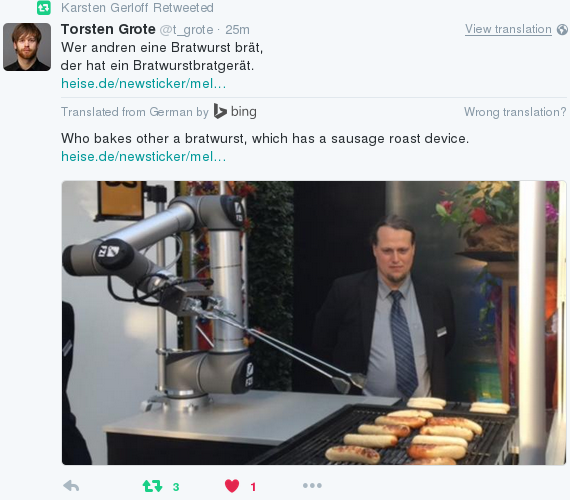
    When it comes to machine translation online, Google Translate and Microsoft’s Bing Translator are serious rivals, not only for custom, but also for the awful quality of the translations they provide.

    Social media platform Twitter has – for reasons best known to itself – decided to use Bing to provide translations of tweets in languages other than the user’s mother tongue.

    However, it’s not very good, suffering as it does from an inability to deal with context.

    Take the screenshot below from a tweet posted by your correspondent earlier this afternoon, who clicked on the Bing translation link out of curiosity.

    screenshot showing dreadful Bing translation

    Bing has managed to mangle my tweet, which contains a colloquial French expression (i.e. “du bidon“) into the incomprehensible “your reporting is Tin“, complete with capitalisation that was not in my original text. Bidon can indeed be a tin – or can or container – in French, but it also has the meaning of belly or stomach too. Furthermore, besides being a noun, bidon can also be used an an adjective, in which context it means phony or bogus.

    Wordreference.com has a brief forum thread on the phrase “c’est du bidon“, which passing Bing Translation developers may like to read.

    In the meantime, if any readers out there are contemplating saving money by using online translation tools instead of a human being, you may like to reconsider.

    Readers interested in why I was retweeting something aimed at the Mail Online website may like to read Tim Fenton’s post debunking the Mail’s Bataclan torture rumours.

  • Blunders at the speed of light

    There was good news this week for Bristol businesses with a yearning for high speed internet connectivity.

    The Bristol Post reported on the deployment of ultra-fast 1 Gbps internet in the city.

    While journalists at the Temple Way Ministry of Truth are quite competent at their main task of churnalism, such as copying and pasting the words of wisdom given in press releases by men in suits – as in the article in question – standards slip dramatically and the absence of sub-editors and the associated lack of quality control are patently obvious when Post staff try simplifying complicated technical concepts, as shown by the following sentence.

    sentence reads These glass cables deliver an internet connection at the speed of light which is highly reliable and efficient

    Shall we just examine the above sentence in detail? There’s plenty wrong with it both technically and grammatically, which schoolchildren sitting their SATs examinations at ages 10 or 11 years would be embarrassed to get wrong.

    Firstly, those glass cables. The proper designation is “optical fibre cable“; and as is well known the correct use of terminology is important. An optical fibre cable is a cable containing one or more optical fibres that are used to carry light, whilst an optical fibre itself is a flexible, transparent fibre made by drawing glass (silica) or plastic to a diameter slightly thicker than that of a human hair. So an optical fibre cable can be made of either glass or plastic, i.e. not solely glass.

    Data from an internet connection is transmitted as light down an optical fibre cable. Light travels at the speed of light. However, it is the method for providing the internet connection which is “highly reliable and efficient, not the speed of light. The subordinate clause, i.e. “which is highly reliable and efficient is misplaced and should at any rate have been preceded by a comma.

    Finally, there’s that speed of light; it’s so reliable and efficient that its precise value is 299,792,458 metres per second (approximately 3.00×10⁸ m/s). It is commonly denoted as c, as in Einstein’s famous mass–energy equivalence formula. Furthermore, c is the maximum speed at which all matter – and hence information – in the universe can travel.

    In the slightly better old days when the Post still employed proper sub-editors, any decent holder of that position would have taken that sentence to bits and re-written it roughly as follows:-

    These fibre optic cables deliver an internet connection reliably and efficiently at the speed of light.

    Or alternatively:

    These fibre optic cables deliver a reliable, efficient internet connection at the speed of light.

    Unfortunately, local newspapers and their online analogues nowadays seem to have forgotten that quality matters and with quality comes a reputation and with the latter, authority.

Posts navigation