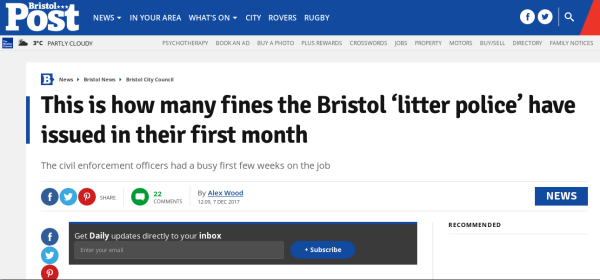
Yesterday’s Bristol Post reported on the first month of operation of what it’s dubbed the “litter police”, the private contractors brought in by Bristol City Council to take enforcement action on such environmental crimes as dropping cigarette ends, littering, failing to clear up the mess of one’s dog, tagging and spitting.
They’ve had a busy first month, issuing 1,368 fixed penalty notices with a total value of nearly £70,000.
Whilst this long overdue enhanced enforcement against the untidy is welcome (as a founder of Tidy BS5 I wholeheartedly support their engagement by BCC. Ed.), it’s not the numbers that interest me, but the Post’s choice of language, particularly at the top of the article, which is reproduced below.
Look between the headline and the byline and you’ll see the following sentence: “The civil enforcement officers had a busy first few weeks on the job“.
All you Brits can stop sniggering.
Now!
“On the job” in the sense of something related to work is, to the best of my knowledge, an import from American English that has in recent decades started appearing increasingly in British corporate jargon. During my youth over 4 decades ago, the phrase had only one meaning and that had salacious connotations.
Collins Dictionary gives the following definitions for the phrase in British English:
actively engaged in one’s employment;
(taboo) engaged in sexual intercourse.
As regards the first definition, this could cover tuition given during employment (e.g. on the job training): no further explanation is required for the second.
The print edition of Scotland’s The National newspaper has an interesting take on the latest Brexit shambles, a comedy of epic proportions if only it were no so tragic.
No further comment required.
Readers may like to leave their comments below on the likely impact of Brexit. 😀
Today’s Times has discovered a new word being used by younger people in the UK, i.e. “Brexity“.
It turns up in a comment piece by Janice Turner admonishing those outward-looking folk who voted to remain in the EU in that disastrous referendum for continuing to criticise the isolationist Little Englanders who voted to undo 4 decades of European integration and dragging a partly reluctant UK into a more modern era.
Ms Turner’s piece gives a couple of examples of the usage of “Brexity“. For instance, concerning places: “It was this horrible Brexity little town“; and food: “He ate this disgusting Brexity pasty“.
According to Ms Turner, it denotes something low-grade, provincial, unsophisticated; enjoyed or frequented by the old, the white working class.
Brexit Monstrosity float in Manchester. Image by Robert Mandel courtesy of Wikimedia Commons.
I understand it is now coined freely in youth slang to mean trashy & tawdry. The young have a good eye, but are cruel. OTOH it is their future that is being trashed & were denied a vote. They have the right to complain. I am sure they will rejoin as soon as they are old enough to.
Quite. Those under 18 have even greater grounds for being upset as they were denied a vote in the referendum, unlike the 2014 Scottish independence referendum when all Scots over 16 years of age were given a say.
Getting rather old and coming from white working class stock, your correspondent hopes his readers won’t find him and his attitudes too Brexity. 😀
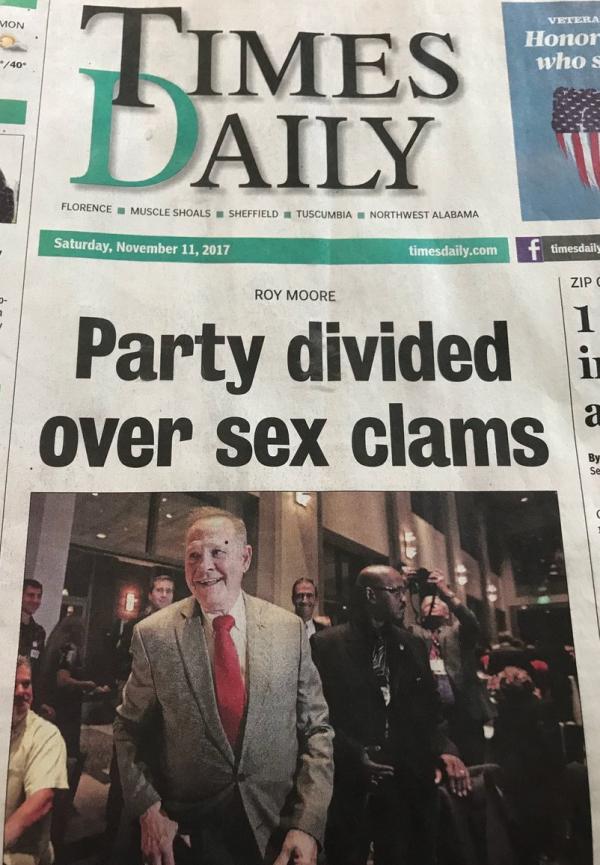
Many press organisations have sacked sub-editors and dispensed with proofreading in recent years as a means of saving money.
Alabama’s Times Daily in the USA seems to have been part of this movement, as is apparent from the following photo of its front page today on the unfolding story of former Alabama state judge and Republican politician Roy Moore‘s past sexual indiscretions.
If one were dining out, what would be the right wine to accompany sex clams? 😉
Yesterday The Document Foundation (TDF) announced the release of LibreOffice 5.4.3, the third minor release of LibreOffice 5.4 family, which includes some 50 bug and regression fixes.
LibreOffice 5.4.3 represents this free and open source office suite’s very latest in terms of features and is therefore targeted at technology enthusiasts and early adopters.
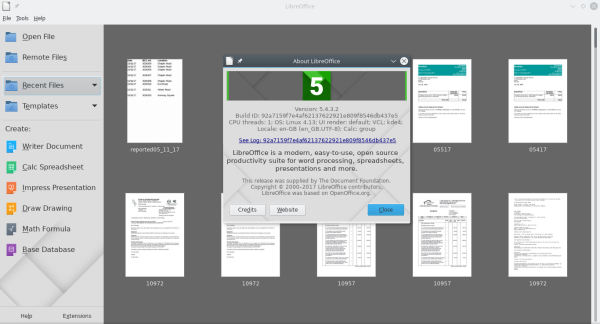
LibreOffice 5.4.3.2 running on the author’s laptop
Download LibreOffice
LibreOffice 5.4.3 is available for immediate download for all major operating systems – Linux, MacOS and Windows.
Your ‘umble scribe has now downloaded and installed the latest release and it works beautifully.
Donate to LibreOffice
LibreOffice users, free software advocates and community members can support The Document Foundation with a donation. Donations help TDF to maintain its infrastructure, share knowledge and organise events such as the Month of LibreOffice, which has last week and will be active until the end of November (https://blog.documentfoundation.org/).
Finally, several companies sitting in TDF’s Advisory Board provide either value-added long-term support (LTS) versions of LibreOffice or consultancy services for migrations and training.
Last weekend once again saw your ‘umble scribe and his friend André helping out (posts passim) with the 2 major elements – bonfire and fireworks respectively – of the Trinity Centre‘s Bonfire Night event, which was recast this year as a “Festival of Light“.
While setting up, André showed me one of the fireworks he would be setting off. It’s shown in the picture below.
As he remarked at the time, it’s good to know firework manufacturers have a sense of humour, let alone one that harks back to a classic of British TV comedy dating from 1976 originally written by one Gerald Wiley.
Once again, my thanks to the good folks at Trinity for a great event.
Spotted on Devon House in Whitehall Road, Bristol, this morning.
This fine old building, which has a Georgian core, is currently being refurbished for some sort of supported or sheltered housing scheme.
However, whoever thought up the “Supported Independence” text on the sign doesn’t really understand English and probably couldn’t even begin to say what constitutes an oxymoron, i.e. an epigrammatic effect, by which contradictory terms are used in conjunction. .
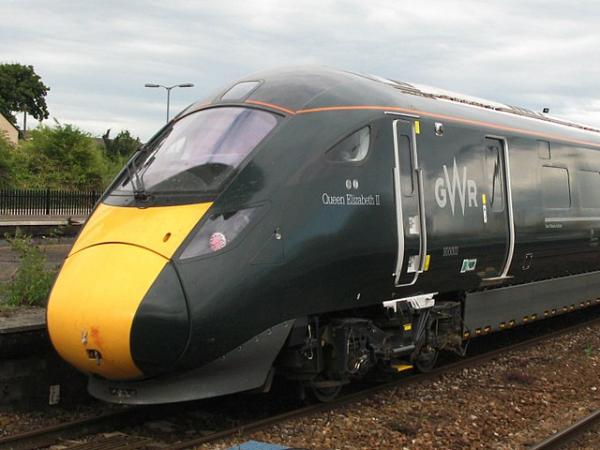
Earlier this week Wales Online reported that train company Great Western Railway will not have Welsh language announcements or signs on its new class 800 fleet that will be providing services on the Great Western route from South Wales to London Paddington.
Class 800 locomotive in GWR livery. Photo courtesy of Wikimedia Commons
The lack of Welsh language announcements or signs on board was first spotted by Cardiff City Labour councillor and Welsh learner Phil Bale, who raised the matter with Great Western Railway via social media.
GWR responded to Cllr. Bale as follows:
I’m afraid we have no plans to have bilingual signage and on-board announcements on these services.
Diolch yn fawr, GWR!
The decision was justified by GWR remarking that the trains serve both England and Wales they aren’t a dedicated South Wales Fleet. However, as a patronising nod in the direction of Wales having a distinct language, GWR did point out that it had leaflets available in Welsh, but passengers would have to ask for them first (presumably in English. Ed.).
In response to GWR’s monoglot policy, Councillor Bales remarked: “For me it shows that Great Western are stuck in the dark ages. We have a Welsh Government target of one million Welsh speakers and there are international transport operators who manage to provide their services in different languages all across Europe.”
As the trains do serve both countries, one would have thought that providing bilingual announcements and signs would have been a common courtesy to those who speak Welsh; and as for Councillor Bales’ remark about running services in other countries, your correspondent doesn’t believe the travelling public overseas would tolerate the incompetence and sheer bloody-mindedness of GWR.
GWR’s attitude contrasts sharply with that of fellow train company, Arriva Trains Wales, which also runs services between Wales and England (e.g. from Cardiff Central to Manchester Piccadilly. Ed.). Arriva provides both signs and announcements in both Welsh and English, as well as bilingual ticket machines and timetables, even at English stations.
Plaid Cymru described GWR’s attitude as “disrespectful“, whilst a Cymdeithas yr Iaith (Welsh Language Society) spokesman said: “Ensuring bilingual signage and announcements on trains in Wales is a matter of basic respect for the Welsh language – there is no excuse not to. The fact GWR have said they don’t intend even to ensure these simple things, and that they’ve missed easy opportunities to do so, shows that they are not a suitable organisation to provide a train service in Wales.
“The Welsh Government should publish strong language standards in the transport sector so that the Welsh Language Commissioner can force companies like GWR to respect the language.”
According to the South Wales Argus, a Welsh Language Commission spokesman said: “Great Western’s alleged lack of investment in the Welsh language is a cause for concern.
“In 2016 the Commissioner submitted a report to the Welsh Government recommending that Welsh language standards should be placed on train companies. The Commissioner continues to work with train companies and others to develop the use of the Welsh language on a voluntary basis, and discusses public concerns with them.”
Yesterday The Document Foundation (TDF) announced the release of LibreOffice 5.4.2, the second minor release of the LibreOffice 5.4 family. LibreOffice 5.4.2 continues to represent the bleeding edge in terms of features and as such is targeted at technology enthusiasts and early adopters.
LibreOffice 5.4.2 includes approximately 100 bug and regression fixes. Technical details about the release can be found in the RC1 (release candidate) and RC2 change logs.
Download LibreOffice
LibreOffice 5.4.2 is available for download for all major platforms (Linux, MacOS and Windows).
Donate to LibreOffice
LibreOffice users, free software advocates and community members are invited to support the work of The Document Foundation with a donation. Donations help TDF to maintain its infrastructure, share knowledge, and organise events such as the LibreOffice Conference, with the next one taking place next week in Rome.
LibreOffice wins survey amongst Ubuntu users
LibreOffice was the runaway winner in a survey of Ubuntu Linux users for desktop productivity software with 85.52% of the votes. The closest competitors were Google Docs with 4.29%, WPS Office with 3.22% and Apache OpenOffice with 1.96%, while all other office suites accounted for less than 1% responses.
“Even with Windows shipping Ubuntu/Bash on their desktop, even with Google shipping Chromebooks with Linux+Chrome pre-installed, even with Mac OS running away with a premium segment of the desktop market, even with Android phones and tablets, there are many tens of millions of passionate Ubuntu desktop users who are eager to have their voices heard! And LibreOffice continues to be THE enabler of local office productivity on the Ubuntu Desktop,” says Dustin Kirkland, Vice-President of Product Development for Ubuntu at Canonical.
The results of the Ubuntu 18.04 LTS Default Desktop Applications Survey were presented by Dustin Kirkland at the UbuCon Europe conference in Paris in September.