tech

  • Bristol Crown Court judge resorts to Google Translate

    Bristol Crown CourtThe shambles that is the Ministry of Justice’s outsourcing of court interpreting services continues, although it does not have such a high media profile these days.

    Today’s Bristol Post reports that a judge was forced to use Google Translate to discuss a case with the defendant.

    Bath resident Jaroslaw Nowacki was appearing at Bristol Crown Court on Wednesday 30th August to answer a charge of possession of a kitchen knife in a public place without good reason or lawful authority.

    However, His Honour Judge Euan Ambrose was unaware until the hearing that Nowacki would need the services an interpreter.

    After confirming the defendant was originally from Poland, the judge decided to adjourn the plea hearing until 6th September to arrange for an interpreter to be in attendance.

    The Post continues:

    But due to Nowacki’s limited grasp of English, he did not understand what he was being told and Judge Ambrose turned to Google Translate to get his message across.

    “Whether Google Translate will accurately translate what I want to say I don’t know,” said the judge.

    After spending several minutes typing out a message, Judge Ambrose printed it off and it was handed to Nowacki for him to read in the dock.

    Nowacki then confirmed that he understood the message and the case was adjourned.
  • Two point releases for LibreOffice

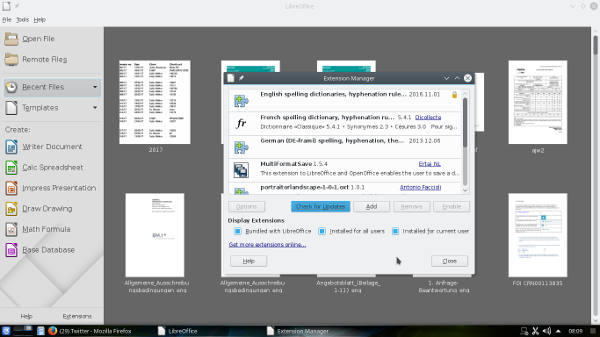
    On the last day of August, The Document Foundation (TDF) announced two point releases for the popular LibreOffice productivity suite: LibreOffice 5.4.1 “Fresh”, the first minor release of the new LibreOffice 5.4 family; and LibreOffice 5.3.6 “Still”, the sixth release of the mature LibreOffice 5.3 family.

    LibreOffice 5.4.1 represents the bleeding edge in term of features, and as such is targeted at technology enthusiasts and early adopters, whereas LibreOffice 5.3.6 is targeted at more conservative users and enterprise deployments.

    As regards enterprise use, TDF suggests deploying LibreOffice 5.3.6 with support from certified professionals. Furthermore, many companies sitting on TDF’s Advisory Board also provide either value-added Long Term Supported versions of LibreOffice or consultancy services for migration to LibreOffice and training.

    LibreOffice 5.4.1 includes approximately 100 bug and regression fixes, along with document compatibility improvements. Technical details about the bug fixes can be found in the RC1 and RC2 change logs.

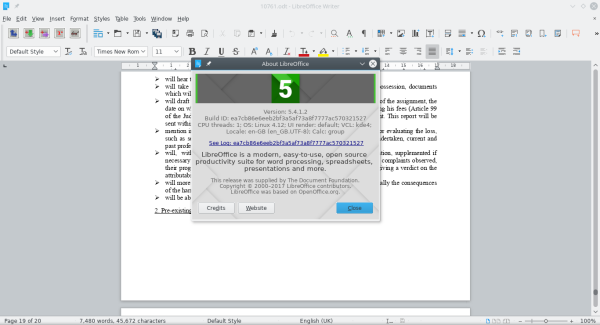
    LibreOffice 5.4.1 screenshot
    LibreOffice 5.4.1 (Writer) in action

    LibreOffice 5.3.6 includes approximately 50 bug and regression fixes. As with 5.4.1, technical details about the release can be found in the change log.

    Download LibreOffice

    LibreOffice 5.4.1 and LibreOffice 5.3.6 are available for immediate download for GNU/Linux, Mac OSX and Windows. Select the version you desire for your preferred operating system.

    Please note that if you’re still using Windows XP or Windows Vista, LibreOffice 5.4 will be the last release that will run on those legacy operating systems.

    Support LibreOffice

    LibreOffice users, free software advocates and community members are invited to support The Document Foundation with a donation. Donations help TDF to maintain its infrastructure, share knowledge and organise events, such as this year’s LibreOffice Conference, which will be taking place in Rome in October.

  • Ambiguity

    Throughout my professional life, writing so that one’s meaning is clear and there is no room for misinterpretation has been of paramount importance.

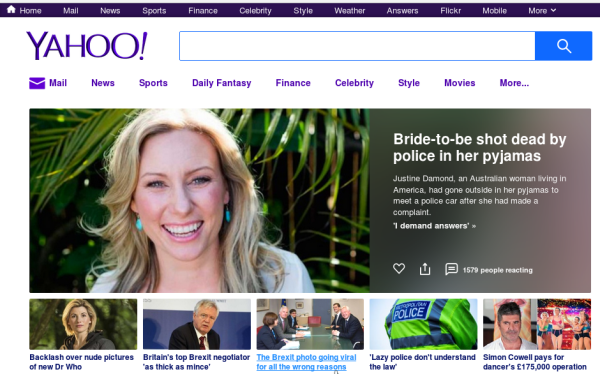
    However, writing without ambiguity is a skill that’s evidently bypassed those who currently write the news headlines for Yahoo’s UK website…

    caption to news story reads bride-to-be shot dead by police in her pyjamas

    Enquiries are continuing as to how the cops came to be in the woman’s pyjamas in the first place. 😀

  • Day against DRM

    Defective by Design buttonToday, Sunday 9th July, is the Day against DRM.
    DRM is the software that comes bolted to your digital media and computerised devices and tries to police your behaviour. The major media companies are its masters, and they justify it as a necessary evil to prevent file sharing.

    However, it does more than that and also does worse than that: DRM gives its owners power over our cars, medical devices, phones, computers and more; in addition, it opens a deep crack in our digital rights and freedoms – a crack will only get wider and more dangerous as our societies continue to interweave with technology.

    I support the global campaign led by the Free Software Foundation (FSF) to raise the awareness of issues related to the so-called Digital Rights Management software. As any other proprietary technology, DRM is killing user freedom of choice and should therefore always be avoided.

    For more details, see Defective by Design’s dedicated Day Against DRM page.

  • IATE reaches double figures

    As a linguist one of the great developments in the way I work has been the development of online resources in recent years.

    These vary from dictionaries to terminological databases and it’s one of the latter that this post is about.

    Last week, IATE celebrated its tenth anniversary of being accessible to the public and proudly publicised its entry into double figures.

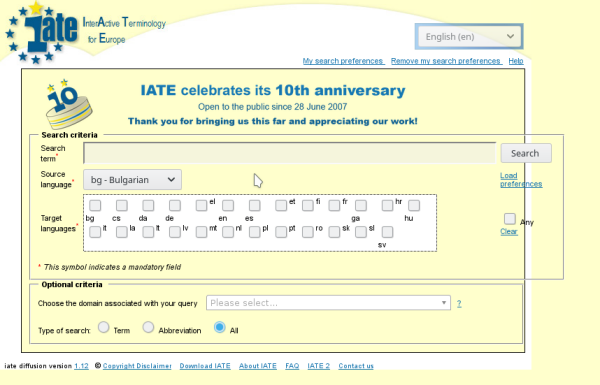
    screenshot of IATE website celebrating 10 years

    As can be seen from the screenshot IATE is short for InterActive Terminology for Europe; and it’s a great resource. Searches can be conducted in language pairs from the following languages:

    • Bulgarian
    • Czech
    • Danish
    • German
    • Greek
    • English
    • Spanish
    • Finnish
    • French
    • Irish
    • Croatian
    • Hungarian
    • Italian
    • Latin
    • Lithuanian
    • Latvian
    • Maltese
    • Dutch
    • Polish
    • Portuguese
    • Romanian
    • Slovak
    • Slovenian
    • Swedish

    Searches can also be refined by picking specialist subject areas from, for example, accounting to the wood industry.

    It’s a particularly good resource for terminology involving the European institutions, political matters and international relations in general, but is also no slouch when it comes to specific terms for, say, forestry.

    History & background

    IATE is the EU’s inter-institutional terminology database. IATE has been used in the EU institutions and agencies since summer 2004 for the collection, dissemination and shared management of EU-specific terminology. The project partners are:

    • European Commission
    • European Parliament
    • Council of Ministers
    • Court of Justice
    • Court of Auditors
    • Economic & Social Committee
    • Committee of the Regions
    • European Central Bank
    • European Investment Bank
    • Translation Centre for the Bodies of the EU

    The project was launched in 1999 with the objective of providing a web-based infrastructure for all EU terminology resources, enhancing the availability and standardisation of the information.

    IATE incorporates all of the existing terminology databases of the EU’s translation services into a single new, highly interactive and accessible inter-institutional database. Legacy databases from EU institutions have been imported into IATE, which now contains some 1.4 million multilingual entries.

    The IATE website is administered by the Translation Centre for the Bodies of the European Union in Luxembourg on behalf of the project partners.

    Download the database

    Having been produced at public expense, the entire database has been opened up to the public can be downloaded, all 1.4 million entries!

    Happy birthday, IATE! Here’s to the next 10 years

  • LibreOffice uses Google’s OSS-Fuzz for quality improvements

    For the last five months, The Document Foundation, the non-profit organisation behind the popular free and open source LibreOffice productivity suite, has made use of OSS-Fuzz, Google’s effort to make open source software more secure and stable, to improve the quality and reliability of LibreOffice’s source code still further. Developers have used the continuous and automated fuzzing process, which often highlights problem just hours after they appear in the upstream code repository, to solve bugs – and potential security issues – before the next binary release.

    LibreOffice 5.3.3 running on the author's Debian GNU/Linux laptop
    LibreOffice 5.3.3 running on the author’s Debian GNU/Linux laptop

    LibreOffice is the first free office suite in the marketplace to make use of Google’s OSS-Fuzz. The service, which is associated with other source code scanning tools such as Coverity, has been integrated into LibreOffice’s security processes – under the leadership of Red Hat – to improve the source code’s quality significantly.

    According to Coverity Scan’s last report, LibreOffice has an industry leading defect density of 0.01 per 1,000 lines of code (based on 6,357,292 lines of code analysed on 15th May 2017). “We have been using OSS-Fuzz, like we use Coverity, to catch bugs – some of which may turn into security issues – before the release. So far, we have been able to solve all of the 33 bugs identified by OSS-Fuzz well in advance over the date of disclosure”, says Red Hat’s Caolán McNamara, a senior developer and LibreOffice’s security team leader.

    Further information about Google OSS-Fuzz is available on the project’s GitHub homepage and on the Google Open Source Blog.

  • LibreOffice 5.3.3 released

    Yesterday The Document Foundation (TDF) announced the release of LibreOffice 5.3.3, the latest release of the “fresh” series, which is aimed at early adopters, power users and technology enthusiasts.

    For more conservative users and enterprise deployments, TDF suggests LibreOffice 5.2.7, the latest “still” series release, with the backing of professional support by certified professionals.

    Compared with its predecessor, LibreOffice 5.3.3 incorporates more than 70 patches, including an update of the Sifr monochrome icon set and several fixes for interoperability with Microsoft Office file formats.

    LibreOffice 5.3.3 running on the author's Debian GNU/Linux laptop
    LibreOffice 5.3.3 running on the author’s Debian GNU/Linux laptop

    As regards those 70 patches mentioned above, users can see which bugs they’ve help to fix in both release candidates, RC1 and RC2 respectively.

    Download LibreOffice

    LibreOffice 5.3.3 is immediately available for download for all major platforms – GNU/Linux, Mac OSX and Windows. If your GNU/Linux system can handle Flatpak format, there’s a special link for that.

    Support LibreOffice with a donation

    As with every release, LibreOffice users, free software advocates and community members are invited to support TDF’s work with a donation.

  • Hello Slimbook Excálibur

    Courtesy of MuyLinux, I’ve become aware of the Slimbook Excálibur, a 15-inch laptop with an aluminium body and backlit keyboard.

    From the video, it’s a smart-looking piece of equipment.

    The machine’s specification is as follows:

    • Intel i5-6200U / i7-6500U CPU
    • Dedicated NVIDIA GeForce 940M 2GB GPU
    • 4GB / 8GB / 16GB DDR 3 RAM
    • 120GB / 250GB / 500GB SSD
    • Optional 500GB / 1TB / 2TB HDD

    Slimbook has a selection of up to 11 Linux distributions, including Antergos, Debian, elementary OS, Fedora, KDE Neon, Kubuntu, Linux Mint, openSUSE, Ubuntu, Ubuntu MATE and Xubuntu, which can be pre-installed; or those desperate for their fix of proprietary can also have Windows installed instead if they pay the necessary licence fee.

    Excálibur pricing starts at €799.

  • Debian to shut down its public FTP servers

    Debian logoDebian is a mature Linux distribution that serves as the basis for many other distros, such as the Ubuntu family.

    Your ‘umble scribe has been a loyal Debian user for at least a decade and has always found it to be secure, stable and reliable operating system.

    Since its inception, Debian has offered downloads of its disk images by both the FTP and HTTP network protocols.

    However, Debian news has now announced that its public FTP service will be closed down in November 2017.

    The relevant text of the announcement is reproduced below.

    After many years of serving the needs of our users, and some more of declining usage in favor of better options, all public-facing debian.org FTP services will be shut down on November 1, 2017. These are:

    • ftp://ftp.debian.org
    • ftp://security.debian.org

    This decision is driven by the following considerations:

    • FTP servers have no support for caching or acceleration.
    • Most software implementations have stagnated
      and are awkward to use and configure.
    • Usage of the FTP servers is pretty low as our own installer has not offered FTP as a way to access mirrors for over ten years.
    • The protocol is inefficient and requires adding awkward kludges to firewalls and load-balancing daemons.

    Information for users

    The DNS names ftp.debian.org and ftp.<CC>.debian.org will remain the same. The mirrors should just be accessed using HTTP instead:

    • http://ftp.debian.org
    • http://security.debian.org

    Information for developers

    Our developer services will not be affected. These are the upload queues for both the main and the security archive:

    • ftp://ftp.upload.debian.org
    • ftp://security-master.debian.org
  • First LibreOffice 5.4 bug hunting session soon

    The first bug hunting session for LibreOffice 5.4 – the next major release of this popular free and open source office suite – has been announced on The Document Foundation blog.

    bug hunt banner giving details

    LibreOffice 5.4 is due to be released at the end of July with many new features: those already implemented are summarised on the release notes wiki page; and there are still more new features to be disclosed.

    The LibreOffice QA team is organizing the first Bug Hunting Session on Friday 28th April to find, report and triage bugs. Testing will be carried out on the first alpha release of LibreOffice 5.4, which will be made available (for Linux, Mac OS X and Windows) on the pre-releases server shortly before the session.

    Full details of the event are available on the specific wiki page.

    Mentors to help testers report and confirm bugs will be available on 28th April from 8.00 a.m. UTC to 10.00 p.m. UTC. Moreover, as this this particular Alpha release (LibreOffice 5.4.0 Alpha1) will be available until the middle of May, hunting bugs will also be possible on other days.

    During the day there will be two dedicated sessions: the first to chase bugs on the main LibreOffice modules between 3.00 p.m. UTC and 5.00 p.m. UTC; and the second to test a set of the top 7 features between 5.00 p.m. UTC and 7.00 p.m. UTC.

Posts navigation