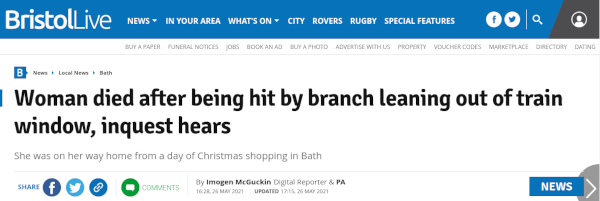
Today the WalesOnline website features a textbook example of an ambiguous headline, i.e one that has or expresses more than one possible meaning.
Ambiguity in a headline – or anywhere else in a piece of factual reporting – is not an example of good writing style.
A headline should be clear, convey sufficient information to interest or pique the curiosity the (potential) reader and not be capable of being misinterpreted.
WalesOnline is part of the Reach plc* stable of regional press titles.
Reach titles have past form with ambiguous headlines (posts passim).
One would almost think it’s written into the group’s style guide (if it has one. Ed.).
* The Reach stable also includes the national titles, the Daily Mirror and Daily Brexit (which some still call the Express. Ed.)
Yesterday the Information Commissioner’s Office (ICO) reported that it had fined American Express Services Europe Ltd. (Amex) £90,000 for sending four million unlawful, unsolicited marketing emails.
IT news site The Register has done some number crunching and worked out that the fine imposed by the ICO is equivalent to 0.021p per offending email or 0.009 per cent of Amex’s annual profits.
The regulator instigated investigations after receiving complaints from American Express customers who had specifically opted out of receiving marketing information. During its investigation the ICO found that American Express had sent over 50 million so-called “servicing emails” to customers (which anyone sensible would call spam. Ed.). The ICO revealed that between 1st June 2018 and 21st May 2019, over 4 million of those emails were marketing emails, designed to encourage customers to make purchases on their cards, thus benefiting the company financially.
Andy Curry, the ICO’s Head of Investigations said:
This is a clear example of a company getting it wrong and now facing the reputational consequences of that error.
The emails in question all clearly contained marketing material, as they sought to persuade and encourage customers to use their card to make purchases. Amex’s arguments, which included, that customers would be disadvantaged if they weren’t aware of campaigns, and that the emails were a requirement of its Credit Agreements with customers, were groundless.
Our investigation was initiated from just a handful of complaints from customers, tired of being interrupted with emails they did not want to receive. I would encourage all companies to revisit their procedures and familiarise themselves with the differences between a service email and a marketing email, and ensure their email communications with customers are compliant with the law.
Francoinfo reports that Le Petit Robert, a popular single-volume French dictionary, reckons that “usage is law” and considers that the word “covid” is used as a masculine noun in the majority of French-speaking countries.
In its 2022 edition, Le Petit Robert, one of the two major commercial dictionaries in France (the other being Larousse. Ed.), reckons the word “covid” is written with a lower case first letter and is also masculine.
To designate the viral disease which has spread throughout the world, Robert distinguishes the generic term “covid“, as in the example “suspected covid“, and the specific one of “Covid-19” with a capital letter. Robert’s definition of “covid” is: “Infectious and contagious disease caused by a coronavirus”.
Its competitor Larousse consistently uses a capital first letter, i.e. “COVID-19” or “Covid-19“.
Its gender has been the subject of doubts in French. For Le Petit Robert, it is “masculine or feminine“, but more often masculine, whereas for Larousse, it is “feminine or masculine“: more correct as feminine, but masculine for many speakers.
When introducing its 2022 edition of the dictionary, Le Petit Robert reckons that “it is usage that dictates the law. If the feminine is adopted in French-speaking Canada, the masculine is currently used by the majority in France where the opinion of the Académie Française (the principal French council for matters pertaining to the French language. Ed.) has been late in coming, whilst the masculine was already well established”.
Rush of words linked to the pandemic
Le Petit Robert has added several words linked to the pandemic, some of which are very current in today’s language, such as “déconfinement” (end(ing) or lifting of lockdown), and rarer ones such as “aérosolisation” (“airborne diffusion of fine particles by aerosol”).
French is not the only language to have experienced a surge of neologisms linked to the pandemic. German broadcaster Deutsche Welle reports that 1,200 new German terms have been inspired by this global health crisis.
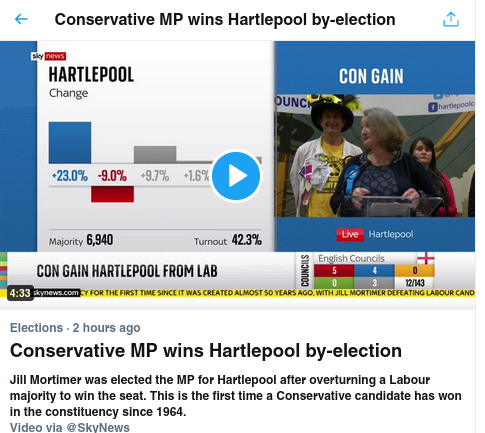
The media and social media today are awash with the result of yesterday’s Hartlepool by-election which was surprisingly won from Labour by the Tories*.
However, some of the language being used to describe the victory is prone to error, such as the example below from Twitter’s trending topics.
As the winning Tory was not the sitting MP, the correct way to describe her is as a candidate, not an MP. She only becomes an MP upon winning a parliamentary (by-)election.
In times past such a basic error would have been picked by a sub-editor or similar, but they were all dispensed with some years ago. 🙁
*= Hartlepool hasn’t had a Tory Member of Parliament since it was represented in Westminster by Peter Mandelson. 😉
Even though the elderly have had a bath thanks to ambiguity and poor proofreading in the Evesham Journal’s dead tree version, this age discrimination has thankfully been eliminated from the paper’s online version of the report.
No pensioners were harmed – or dunked – in the drafting of this blog post.
Being born in the mid-50s, some of my main childhood memories include the Cold War rivalry of the “Space Race” between the then USSR and the USA, all reinforced by such TV fare as Jerry and Sylvia Anderson’s Fireball XL5.
These have stayed with me throughout life and I still follow human achievements in space closely.
Coming hard on the heels of the Ubiquity helicopter’s first flight on Mars (posts passim), German IT news website heise reports that NASA’s next lunar rover will also be powered by free and open source software.
In 2023 NASA will launch its Viper (Volatiles Investigating Polar Exploration Rover) rover which will be searching for and mapping water ice (which could one day be used to make rocket fuel) on the Moon’s surface. The rover will be equipped with high-tech instruments and tools: wheels which can revolve well on the dusty lunar surface; a drill which can dig into the lunar soil and hardware which can survive the lunar night which lasts 14 days and during which temperatures can drop to -173 degrees Celsius.
Image courtesy of NASA
Whereas Viper’s equipment is largely bespoke, the rover will run mostly on open source software which can be freely used and adapted. If the mission is successful, it will not only lay the foundations for a future Moon colony, but also enable the aerospace industry to develop and operate its robots in a different manner.
Open source technology has been little thought of to date in respect of space missions. It costs vast sums to build something space-worthy which can find its way to a target hundreds of thousands of kilometres away and carry out its specific tasks there. The natural impulse is usually to conceal the necessary know-how. On the other hand, open source software is often associated with cobbled-together programming for small projects such as hackathons or student demonstrations. The programming code that fills online repositories like GitHub is often a cheap alternative for groups with little money and few resources.
Into space with open source
The aerospace industry is being propelled forward by many factors, not least the increasing drive into space. This also entails a demand for cheap and accessible technologies, including software. Even for major organisations like NASA, for whom funds are less of a problem, the open source approach can result in better software. With open source, scientists can access additional expertise and feedback from a wider community when problems arise, just as amateur developers do.
If open source software is good enough for the likes of NASA, it should probably also be good enough for everyone else trying to control a robot remotely from Earth. As ever more new companies and new national agencies throughout the world are trying to send their own hardware into space and at the same time keep costs down, cheaper robotics software able to cope with risky missions could be a major benefit.
NASA has already been using open source software for 10-15 years in several research and development projects. It manages a very comprehensive range of open source program code. However, its use for space robots is still in the initial stages. One of the systems the agency has tested is the Robot Operating System (ROS), a collection of open source software frameworks which is maintained by Open Robotics, a non-profit which is based in Mountain View, California. ROS is already used in the Robonaut 2 humanoid robot, which has assisted in the International Space Station’s research, and in the autonomous Astrobee robots, which float around the ISS supporting astronauts in their routine tasks.
The ROS will carry out ground flight control tasks. NASA staff will control the Viper rover from Earth. Ground flight control will then use the data collected by Viper for a real-time map and rendering of the lunar environment, with which the rover’s drivers will then be able to navigate more safely. Other parts of the rover’s software also have open source roots: the “Core Flight System” (cFS) program, which NASA developed itself and made available free of charge on GitHub, is responsible for basic functions like telemetry and on-board file management. Viper’s mission operations beyond the rover will be carried out by Open MCT, another NASA development.
Viper will be controlled in real time – almost
In addition, the Viper mission is suitable for open source software. Because the Moon is so close, the rover will be able to be controlled almost in real time, meaning that part of the software does not need to be on the rover, but can be run on Earth instead.
However, Viper doesn’t run fully on open source software. For example, its onboard flight system uses reliable proprietary software. Nevertheless it can be assumed that future missions will both use and extend the open source software used for the Viper mission.
One Twitter account I follow is Miss PunnyMany for her insights into Scots English. She’s just asked a very important question of manners and terminology in this tweet, as shown below.
Well, is “hen” rude?
Let us see.
An accurate definition would be a good place to start.
hen: vocative term for a woman (e.g. ‘It’s aw richt, hen’), or a general term of endearment for anyone.
Note the phrase “general term of endearment“. That’s a big clue, indicating that its use is confined to close friends and acquaintances.
This view is largely borne out by the tone of the responses to Miss PunnyMany’s tweet.
Furthermore, a few respondents rightly point out that, like “pal” south of the Border, “hen” may be used in a pejorative or threatening manner to people outside one’s immediate social circle.
You don’t talk shite, hen!
An example of this can be found in a place a fair way from Scotland, namely the chamber of the House of Commons in Westminster.
Back in March 2017, SNP Member of Parliament Mhairi Black gave rise to comment in the media and on social media when appearing to mouth the words “You talk shite, hen” to a response by Tory minister Caroline Nokes, then the Under Secretary of State in the Department for Work and Pensions.
Ms Black had just made an impassioned speech that criticised a Government proposal to withdraw housing benefits for 18-21-year-olds. Her silent, but lip-read comment denoting her clear displeasure came during Ms Nokes’ reply which naturally defended the government’s cruel proposal.
So there you have it, use “hen” sensibly and restrict it to family, close friends and acquaintances, you shouldn’t go too wrong.
Mirror, mirror on the wall, who’s the scruffiest of them all?
Speaking from Chequers, a visibly shocked an astounded Worzel Gummidge apologised to those who had expressed their anger on social media and added: “Anyone would think I always looked as if I’d been dragged through a hedge backwards, like former London Mayor Alexander Boris de Pfeffel Johnson!”
One fascinating aspect of the country’s foolhardy departure from the European Union is the fate of Britons in the 27 member states of the European Union; and more particularly how they are depicted here now that the “free and independent coastal state” of Brexitannia has “taken back control“.
Keen observers of the British media will note all foreigners seeking to come to the English Empire (which some refer to as the United Kingdom. Ed.) to settle are referred to as “migrants“. When used by the right-wing press or politicians, “migrants” has a clear pejorative tone to the effect that these people are not as good as us.
However, in line with British exceptionalism as Brits seeking to or having taken up residence abroad are termed “expats” by the fourth estate, as per this typical specimen from yesterday’s Daily Brexit, which some still call Daily Express.
Expats? Emigrés? Immigrants?
Of course, what the Daily Brexit forgets is that even in Greece and Cyprus, holders of those nice, new and allegedly blue British passports will still be classed as third country citizens by the Greek and Cypriot authorities; and if they try staying there for longer than the maximum period without applying for a residence permit, they’ll be regarded as illegal immigrants, just as they are now finding out on the Costa del Sol.
“Expat” is of course a truncation of the term “expatriate“, with the shorter form’s first recorded use in the first half of the 1960s.
When people move for work, settlement or other reasons, the language used about them is always full of meaning. In earlier, less judgemental times those who left British shores to settle abroad might have been referred to as “émigrés” or “emigrants“, whilst those coming here for permanent settlement were “immigrants“, which had more than its fair share of negative connotations in times past.
Nowadays all those negative connotations are to a certain effect by “migrant“, which, unlike “immigrant” or “emigrant” is not specific about the person’s direction of travel.
Nevertheless, I can see the exceptionalism continuing and am not expecting the Daily Brexit to refer to Brits resident abroad as “British immigrants” at any time soon. 😉