politics

  • Iceland reviews bilingual signage policy in Welsh stores

    Iceland logoFollowing hot on the heels of the sacking of its Director of Corporate Affairs for insulting the Welsh (posts passim), comes news that frozen food giant Iceland is reviewing approach’ to bilingual signage in its Welsh stores.

    The company had previously been criticised for its lack of provision of Welsh and English signage in stores, even attracting protests, such as one in Rhyl in 2018 reported by The Grocer.

    At that time, Iceland was not exactly amenable to bilingual signage in its Welsh stores and even went so far as to issue a statement asserting its monoglot stance: “We do not currently provide signage in any language other than English in any of our stores in any part of the UK or Ireland.

    However, the company, which is based in Glannau Dyfrdwy (English: Deeside), had now announced this is changing, stating:

    “We are currently reviewing our approach to providing Welsh signage in stores across Wales and updating this wherever possible. All new stores and those which are refitted have Welsh signage installed as standard, and this is also in place across all of our The Food Warehouse stores across Wales.”

    The move has received support from Aled Roberts, the Welsh Language Commissioner, who has issued the following statement:

    Research conducted by The Welsh Language Commissioner shows that customers in Wales want to see, hear and use the Welsh language in supermarkets in Wales. We have worked with a number of large supermarkets to develop their Welsh language services, supermarkets such as Coop and Lidl have responded brilliantly to develop a bilingual service. We would like to applaud their approach in working with us. We have contacted Iceland to inspire them to use Welsh, and encourage them to use bilingual signs, and we hope that they will respond to our request.

  • Insert word of choice

    For many years the garage sitting at the apex of the junction of Russelltown Avenue, Cannon Street and Whitehall Road in BS5 has featured a changing sequence of slogans painted by Stan Jones, who lives in the house to which the garage belongs.

    It was 2017 when I first noticed it and, at that time, it focussed on the madness of Brexit.

    Garage wall featuring Exit Brexit slogan
    Exit Brexit

    In 2019 its message was still focussed on Brexit but had been repainted to featur the wording “Buck Foris” (fine use of a Spoonerism there. Ed.) and “Fromage not Farage“, so I think it’s fair to say Stan is not impressed with the right-leaning part of what passes for Britain’s political class.

    In 2019 Stan’s efforts accidentally suffered the attentions of Bristol City Council’s fight against graffit. There was, however, a happy outcome as Stan received an apology and some paint from the corporation, as the Bristol Post reported at the time.

    Below is Stan’s latest contribution, which really needs no further comment from me.

    Text on building reads What the [insert word of choice] is happening?
    Stan’s latest (shame about the tags)


  • The rubber stamp of approval

    Approved stampGoing back to my schooldays over 5 decades ago, I recall being taught in English language classes that to rubber stamp means officially to approve a decision without giving the matter in question any proper scrutiny or thought.


    Rubber stamping is indicative of lack of care, attention and is indicative of perfunctoriness.

    Furthermore, the definition I was taught all those long years ago is confirmed by Collins Dictionary, which states:

    When someone in authority rubber-stamps a decision, plan, or law, they agree to it without thinking about it much.

    Nevertheless, there seems to be a general trend nowadays in the press to use this verb routinely for the approval of any decision, whether or not it is preceded by lengthy or indeed any debate at all.

    It’s as if to rubber stamp has become synonymous with to approve, which is really isn’t.

    One very guilty party in this respect is the Bristol Post, now rebranded as Bristol Live by its Reach plc masters, as per this example from 12th February, where we read:

    The plan is due to be rubber stamped at a council meeting on Monday (February 15).

    If there’s one thing I know about planning meetings (having attended them. Ed.), it’s that their decisions are never rubber stamped, as councillors serving on planning committees generally tend to consider all applications in the most minute detail. There’s no waving agenda items all through in a couple of minutes, so members can retreat early to the pub or somewhere else more interesting than a council meeting room.

    I hope any passing member of the fourth estate will take note of – and act upon – the content of this little post.

  • Gloucestershire Live reveals truth about The Independent Group

    Gloucestershire Live is a sister title of the Bristol Post/Bristol Live and as such provides a similar mediocre quality of journalism to its victims readers.

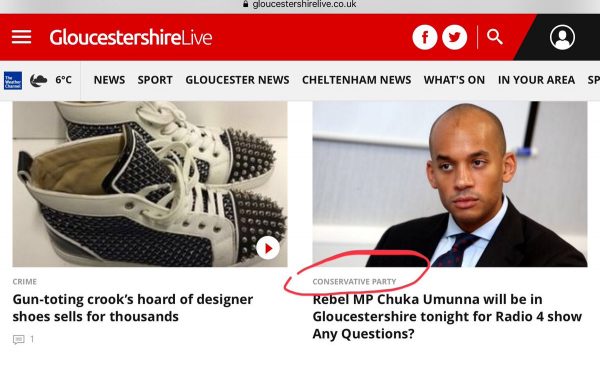
    Yesterday, it shook off that veil of mediocrity – albeit briefly – as its website published an item confirming what many believed concerning the main politics news story of the week: the exit of right-wing MPs from the Labour Party to form a breakaway group, as shown in the screenshot below.

    Header for piece about Chuka Umunna reads Conservatives

    My Gloucestershire friends have this morning confirmed via social media that as far as the governance of the county is concerned, politics inevitably equals the Conservatives and the Blue Team dominate what is effectively a de facto one-party state.

    Hat tip: Westengland.

  • Mold: no interpreter; justice delayed

    Although it’s not hitting the national headlines any more, the Ministry of Justice’s disastrous decision to outsource interpreting services for courts and tribunals in England and Wales continues to delay the administration of justice.

    The latest instance your correspondent has discovered occurred last Friday at Mold, according to the County Times.

    Mold Law Courts
    Mold Law Courts. Image courtesy of Wikimedia Comms.

    That day a case against two Vietnamese defendants, Quan Vu and Bang Vu, had to adjourned as no Vietnamese interpreter had been arranged to attend court for their plea hearing.

    Both defendants are charged with being concerned in the production of cannabis in Newtown in Powys.

    Judge Niclas Parry adjourned the case. A plea hearing will now take place on Friday, 8th March, with the trial date set provisionally for 15th April.

    Mr Justice Parry remarked that a letter of explanation was required as to why no interpreter had been arranged.

    In the meantime both defendants remain in custody.

  • Stupid boy! Another pair of lookalikes

    It’s no secret that Gavin Williamson MP, the current Secretary of State for Defence, is nicknamed Private Pike, after Frank Pike, the fictional Home Guard private and junior bank clerk in the BBC television comedy Dad’s Army, who was frequently referred to by platoon commander Captain Mainwaring as “stupid boy“.

    Composite of Private Pike and Gavin Williamson

    Young Gavin, who is the Member of Parliament for South Staffordshire, had a real stupid boy moment last week.

    On Monday, in a gung-ho speech to the Royal United Services Institute, Williamson confirmed that the first of Britain’s next-generation aircraft carriers, the Queen Elizabeth, will tour the Pacific as part of its maiden voyage and that the vessel likely to tour the South China Sea at a time of growing tensions regarding China’s territorial ambitions.

    Needless to say this has not gone down well in Beijing, resulting in a planned trade visit by Chancellor Philip Hammond being cancelled.

    Even former Chancellor George Osborne has commented, also alluding to Williamson as a stupid boy, but using rather more words, as iNews reports:

    You have got the defence secretary engaging in gunboat diplomacy of a quite old-fashioned kind at the same time as the chancellor of the exchequer and the foreign secretary are going around saying they want a close economic partnership with China.

  • Telegraph exclusive: Brits using ducks to negotiate Brexit

    The right-wing Telegraph newspaper has enjoyed a long and close relationship with the Conservative Party. So close indeed that it is often referred to as the Torygraph.

    This close relationship means that developments within the Tory Party are frequently reported first in the Telegraph.

    It is therefore no surprise that the latest developments on the state of the UK’s Brexit negotiations popped into my Twitter feed this morning with the following Telegraph headline and abstract.

    Image text reads Brexit latest news: Theresa May will meet Jeremy Corbyn today as she prepares to send a revamped negotiating teal back to Brussels.

    Yes, that’s why the negotiations have been so disastrous. They’ve been handled by ducks, or more specifically a Eurasian teal, a male specimen of which is shown below.

    Male Eurasian teal
    A top international negotiator according to the Telegraph. Photograph courtesy of Wikimedia Commons.

    How a duck or ducks actually managed to deal with the question of the Irish backstop remains a mystery and is probably why the Tory right wing is so obsessed with it. And quite what a revamped negotiating teal is, one could indulge in conjecture. Was it taken to some backstreet ornithologist and given the plumage of, say, an Arctic skua, together with a bit of beak remodelling?

    Please Torygraph, tell me it’s not a typo! 😀

  • Public money, public code – new FSFE brochure

    Let’s start with a trio of questions.

    1. Why should governments develop free software*?
    2. Where is free software already generating benefits in the public sector?
    3. What are free software business models?

    Answers to the above questions and practical guidelines are given in the new expert policy brochure published today by the Free Software Foundation Europe.

    Entitled “Public Money Public Code – Modernising Public Infrastructure with Free Software“, the brochure aims to answer decision-takers’ questions about the benefits of using and developing free software for public sector organisations.

    To help understand the important role that public sector procurement plays in this, the brochure presents an overview of EU free software projects and policies, uncovering legislation on software procurement.

    The FSFE will use this brochure in the forthcoming European Parliament elections to inform potential MEPs how to speed up the distribution and development of free software in the public sector and putting appropriate legislation in place.

    Download the brochure (PDF).

    Front cover of FSFE brochure

    The brochure evaluates the modernisation of public infrastructure by using free software from the perspectives of academia, law, business and government. Expert articles, reports and interviews help readers to understand the opportunities for free software in the public sector. Practical guidance is provided for decision-makers to move forward and start modernising public infrastructure with free software.

    FSFE President Matthias Kirschner states: “Free software licences have proven to generate tremendous benefits for the public sector. This is not a trend that will pass, but rather a long-term development that is based on very positive experiences and strategic considerations resulting from serious vendor lock-in cases in the past. In a few years, free software licences could become the default setting for publicly-financed IT projects. The Free Software Foundation Europe watches these developments very carefully and we want to contribute our knowledge to support the public sector in this transition.”

    Initial steps for making free software licenses the default in publicly-financed IT projects are outlined in the brochure. Other topics include competition and potential vendor lock-in, security, democracy, “smart cities” and other important contemporary topics. The language and examples used have been specifically chosen for readers interested in politics and public administrations.

    The brochure features leading experts from various ICT areas. Amongst others, these include Francesca Bria, Chief of Technology and Digital Innovation Officer (CTIO) for the Barcelona City Council, Prof. Dr. Simon Schlauri, author of a detailed legal analysis on the benefits of free software for the Swiss canton of Bern, Cedric Thomas, CEO of OW2, Matthias Stürmer, head of the Research Center for Digital Sustainability at the University of Bern and Basanta Thapa from the Competence Center for Public IT (ÖFIT) within the Fraunhofer Institute for Open Communication Systems.

    The brochure is available in both digital and printed formats, and is published under a CC BY-SA 4.0 licence and I’ll be sending a copy of the PDF to my MP for her information.

    * = In this context the definition of free software is free as in freedom, not beer.

Posts navigation