Dog fouling is one of the banes of modern life; it’s filthy, a health hazard and – as any local councillor will tell you – a permanent source of correspondence for them from the electorate.
Over in Bedminster someone has been patrolling the streets and highlighting the problem of dog fouling by spraying the canine visiting cards left in public places with yellow paint, as shown in the example below from Stillhouse Lane.
Over in BS5, there’s someone else who also goes round the Easton and Redfield areas with a spray can of paint attacking dog faeces, in this case spraying them fluorescent green.
In closing here’s a final reminder to those who let their dogs foul the streets and don’t clean it up: it’s an offence that could land you with a fine of £80, which might be a little more inconvenient than stooping and scooping. 🙂
Following the post on Friday on Bristol City Council‘s response to my open standards FoI request (posts passim), more information has come to light.
It was all sparked by a discussion on Twitter between myself and Alex, a leading member of the Bristol & Bath Linux Users’ Group (BBLUG).
It all revolved around what was really meant by the phrase “not fully digital” in respect of PDF files.
My speculation was that if text documents are scanned, these are usually converted to image-based PDFs with which the screen readers used by blind and visually impaired people can have problems.
It turned out this was a good point, but not the real reason.
The latter was supplied by Gavin Beckett, BCC’s Chief Enterprise Architect, who actually responded to my FoI request. It seems Gavin’s main reason for describing PDFs as “not fully digital” is that PDF is basically an attempt to make electronic files emulate paper. The move by the council away from PDF to HTML when responding to citizens is that more mobile devices (tablets and smartphones) are now being used by the public to communicate with the local authority and the latter wishes to provide the same – i.e. “fully digital” experience to all.
Finally Gavin promised to follow up with his colleagues my gripe about using MS formats for responding to FOI requests. He conceded this was one example where PDF would be better.
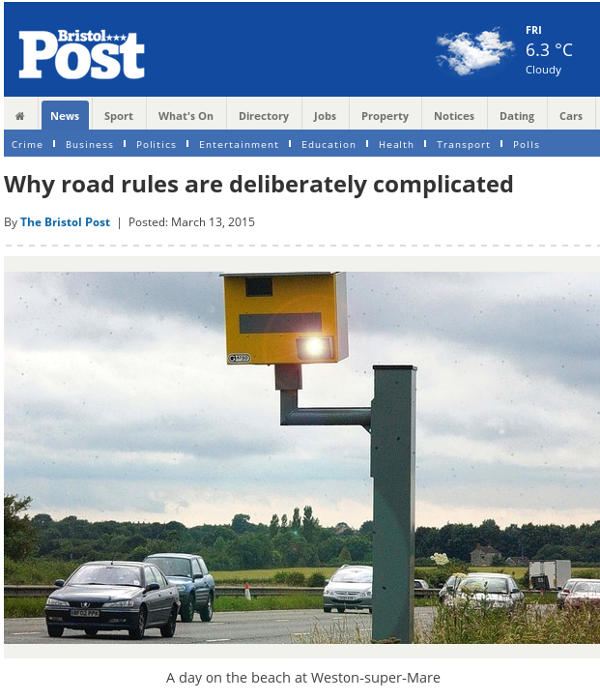
The Bristol Post is not immune to the odd error every five minutes or so and today is no exception, as is amply demonstrated by the screenshot below of an item from today’s online edition.
Even the image tag’s alt attributes include the wording “A day on the beach at Weston-super-Mare”.
If Weston beach has been covered in tarmac and is now reserved for use by motor vehicles, I do hope the highway engineers built it well above the high water mark for spring tides, which have a range sometimes in excess of 13 metres.
On the other hand, the Bristol Post does have form when it comes to writing the wrong captions for images on its website (posts passim).
The reply was received in a record 10 working days and reads as follows:
Bristol City Council has been a long-term supporter of open standards wherever possible. We have frequently voluntarily adopted national government policy on open standards and open source, recognising the benefits of this approach.
We adopted StarOffice in 2005 and moved to the Open Document Format as our standard for office productivity files at the point it was incorporated in the StarOffice / OpenOffice.org products. We had to move to Microsoft Office in 2010 due to the lack of standards support in the local government applications market, partly due to the fact that national government policy was not mandated at local level and therefore did not have the desired effects on the document standards context. However we retained the ability to create, open and collaborate on ODF by implementing LibreOffice alongside Microsoft Office on all council PCs. Therefore we are already capable of using ODF to collaborate on government documents.
In terms of publishing government documents to citizens, we have historically used PDF, but are now attempting to replace all information, advice and guidance, and application forms with fully digital services. Over time this will replace old PDF documents with HTML. If there are documents that meet a user need to download and read offline, we can produce PDF/A format from the open source PDF Creator software that is also available on every council PC.
I’m very pleased to note that BCC has LibreOffice installed on every council machine. They kept that quiet! Perhaps they’ll use it to send me replies to my FoI requests in future instead of the propensity to use MS Office formats. But just to make sure, I’ll include a plea for a reply in an open format in all my future requests. 🙂
Thanks to skimping on proof-reading, La Despensa Del Gourmet, a new Spanish delicatessen that’s recently opened in Prince Street, Bristol has a rather unusual offer at present, which sounds a bargain at £3.50!
Picture courtesy of Bristol Bites
Speculation has it that the proprietors are actually trying to offer a carbonated soft drink originally from America… However, that could be phallusy! 😉
Spotted on the pavement opposite House of Fraser, Cabot Circus, Bristol – one red bra.
Whose could it be?
There’s one person in Bristol who is well known for wearing red – the city’s elected Mayor, George Ferguson.
It is suspected that George has shed his clothing in public before, notably in Easton (posts passim).
Could the Mayor’s secret penchant for transvestism or covert gender reassignment finally have been revealed? If so, when will George tell the citizens of Bristol?
That’s a matter for George’s conscience and our speculation.
However, turning to serious matters, shedding clothing on the highway is technically littering. Bristolians can report litter, fly-tipping, graffiti, dog fouling and the like online via the links on the city council’s street care and cleaning page.
There’s now a petition online calling on Bristol City Council to increase its efforts to get a grip on litter and fly-tipping in its Easton and Lawrence Hill wards (posts passim) and make scenes like the one below of Jane Street in Redfield a thing of the past.
Image courtesy of Amy Harrison
The text of the petition reads as follows:
We, the undersigned, petition Bristol City Council to enforce penalties for fly-tipping and dropping litter and find lasting solutions to these two problems. Easton and Lawrence Hill wards have for many decades suffered from both litter and fly-tipping. Where communal household waste bins have been installed, residents have found that they are used by people from outside the area for disposing of their waste, as well as local traders abusing them to dispose of trade waste. The fly-tipping sometimes involves hazardous materials. Litter and fly-tipping also encourage the presence of vermin such as rats. In some places the communal bins are also used as a cover for unhygienic actions such as defecating and urinating in the street, making them unsafe for children to play in.
As part of the campaign to tidy up the Easton and Lawrence Hill areas of Bristol, we residents are attempting to ensure that we can use all the council services for which we pay through our taxes.
These include such things as recycling collections on Stapleton Road and the provision of adequate recycling facilities in the inner city’s council-owned tower blocks (posts passim).
Bristol City Council’s St Philips Recycling Centre (aka Day’s Road tip). Looks welcoming, doesn’t it?
Another bone of contention was the fact that Bristol City Council’s Day’s Road ‘recycling centre’ (better known to locals as ‘the tip’. Ed.) appeared to be off limits to callers on foot. The Kier/May Gurney staff that run the facility for the council had even gone so far as to place a sign at the entrance stating no callers on foot. Furthermore, I’d heard anecdotally that the reason for this prohibition was down to that favourite old ‘excuse’ – health and safety.
Whenever I make a Freedom of Information (FoI) request to Bristol City Council, the response invariably comes back in a proprietary Microsoft Office format (e.g. .docx, .xlsx, etc.), a practice I find less than satisfactory – not to say galling – as an advocate of free and open source software and open standards.
That being so, the following FoI request has been made today to the council:
Dear Bristol City Council,
This is a request for information under the Freedom of Information Act.
– PDF/A or HTML for viewing government documents;
– Open Document Format (ODF) for sharing or collaborating on government documents.
What plans does Bristol City Council have to emulate central government’s move and when will similar open standards be adopted by the council for communicating and collaborating with citizens.
Yours faithfully,
Steve Woods
Hopefully an answer will be forthcoming by Document Freedom Day 2015 (posts passim).
Yesterday’s Bristol Post reports on the dire state of rented properties in Morton Street, Barton Hill, just down the road from the Little Russell (posts passim).
One of the problems faced by the tenants in question is that they’re having to share their homes with sitting tenants – resident brown rats. This is hardly a conducive environment to live in, let alone one in which to bring up one’s children.
Landlord or sitting tenant? Picture courtesy of Wikimedia Commons
It’s said that no-one is ever more than a few yards away from a rat and these rodents do have any easy life in today’s cities. Their life is made even easier by the proliferation of fast food outlets in recent years combined with the untidy habits of their patrons.
The report really highlights the fact that Bristol is a divided city. While they city’s great and good are indulging in a year of junketing, mutual backslapping and filling each others’ bank accounts with public money courtesy of Bristol Green Capital, its poor are enduring infestations of vermin, plus the seemingly insurmountable inner-city blights of litter and fly-tipping.
Well done to ward councillors Marg Hickman and Hibaq Jama for highlighting this problem and taking up the tenants’ plight.

 Following the post on Friday on