politics

  • Bloody Foreigner!

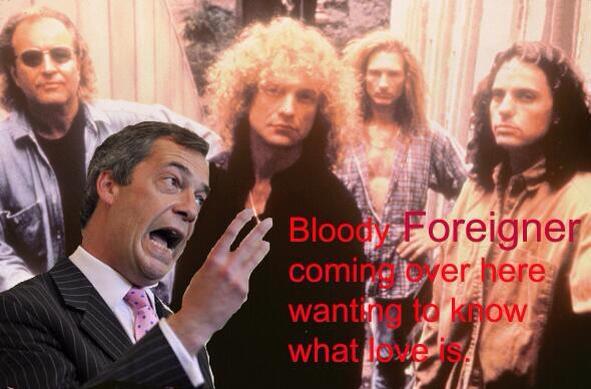
    There has been much scrutiny in the media about UKIP’s xenophobia in the run-up to tomorrow’s European Parliament election.

    Indeed, party leader Nigel Farage got into a little difficulty in a radio interview on LBC last week, giving rise to accusations of racism, something he later explained away as being due to tiredness.

    The picture below (for which Ade Cooper gets a tip of the hat. Ed.) should bring a smile to the face of anyone similarly stricken to me in years who doesn’t share young Nigel’s Little Englander view of the world.

    text on image reads Bloody Foreigner coming over here wanting to know what love is

    To prevent any further incursion of foreigners and/or Foreigner, perhaps the UK should deploy a squadron of Farage balloons around the coast. Similar to the barrage balloons used in the 20th century’s 2 world wars, these isolationist windbags could soon blow any threat of invasion to the shores of Blighty back to whence it came. 🙂

  • Staffordshire oatcake to get protected status?

    Will the Staffordshire oatcake be joining Melton Mowbray pork pies, the Cornish pasty and Newcastle Brown Ale by having its status protected by the European Union?

    Filled Staffordshire oatcakes
    Filled Staffordshire oatcakes. Picture courtesy of Wikimedia Commons

    The BBC reports that the the West Midlands Labour group of MEPs is promising to apply to get it protected by the European Union if re-elected.

    One of the candidates, Sion Simon, is reported as saying: “They’re part of our heritage and culture in the West Midlands and they should be protected in the same way other European countries protect their food products.”

    Conservative and Liberal Democrat candidates are also said to be broadly supportive of the proposal, although UKIP are being curmudgeonly and refusing to support the move (another reason not to vote for Nigel’s Little Englanders? Ed.).

    However, I cannot help wondering if this proposal is a local Labour response to the rise of UKIP, particularly amongst Labour’s long-term core voters – the traditional white working class – the people it has taken for granted for far too long.

    It is unclear from the BBC’s article which type of protection – PDO (Protected Designation of Origin), PGI (Protected Geographical Indication) or TSG (Traditional Speciality Guaranteed) – will be sought, although my feeling is that it should be one of the first two.

    I hope this is not just another manifesto promise from Labour that, like so many others, will be quietly dropped after the election when they have served their purpose.

  • Save Ebenezer Chapel

    The historic Ebenezer Chapel, the last remaining non-conformist chapel in the St Philips area of Bristol, is under threat of demolition from its owners, who seem very unconcerned about its value.

    As a non-conformist building, it is very interesting architecturally too, looking more influenced by the Romanesque or Norman style (as it is otherwise known in England. Ed.) than the more usual Gothic Revival.

    image of Ebenezer Chapel
    Ebenezer Chapel in its days as an architectural salvage emporium. Picture courtesy of John M (via Geograph)

    However, a petition has been started to try and save (some of) it.

    The text of the petition reads as follows:

    Ebenezer Chapel, on Midland Road, is under imminent threat of demolition. The landowner wishes to destroy this important and beautiful reminder of the history of St Philips and Old Market, to replace it with a modern block of flats.

    The chapel was built in 1849, the first Primitive Methodist chapel built in Bristol. Notwithstanding its beauty for local residents and the thousands of pedestrians and cyclists which pass it each day, it is the last-remaining architectural evidence of the education and spiritual support given to the first residents in the area, who settled in the early nineteenth century.

    An attempt has been made to get the building listed by English Heritage, while it is a very strong candidate for the Local List. But because it is not listed and is outside of a conservation area, Bristol City Council says it is powerless to intervene and save this beautiful building.

    We would like your support for this petition, which aims to show how many people would like this building saved and, at the very least, incorporated into any new development that takes place.
    The more public support we receive, the more we can do to persuade the landowner and council to work to save this important historical landmark for future generations, and in so doing create a better development for all.

    As well as signing the petition, please consider writing to your local councillor and local media to express your support for saving the chapel, and calling on them to do all they can in the future to protect the heritage of our great city.

    Sign the petition.

    Easton blogger Ursula Wills-Jones has also written a post on the proposed demolition of the Ebenezer Chapel, describing it as “short-sighted and stupid”.

  • Euro election hustings: a view from the chair

    ORG logoOn Friday evening the Open Rights Group organised one of a series of nationwide European Digital Rights hustings at St Werburgh’s Community Centre in Bristol. This was a chance for local people to quiz MEP candidates from the South West about their views on digital rights and ask them to sign up to the 10 point Charter of Digital Rights.

    Green European Parliament candidate Audaye Elesedy signs the Charter of Digital Rights at St Werburgh's Community Centre
    Green European Parliament candidate Audaye Elesedy signs the Charter of Digital Rights at St Werburgh’s Community Centre. Picture credit: Brent Longborough

    As Chair of St Werburgh’s and having a keen interest in digital rights, I volunteered my services and was surprised to be asked to chair the event.

    When I arrived, Ed Paton-Williams from the ORG had already shown up and there was little to organise in the room apart from setting up the wifi, a couple of notices with the wifi details and the last minute provision of water for the top table.

    In alphabetical order, the candidates who attended were:

    We were supposed to have been joined by Julia Reed from UKIP, but she pulled out at the last moment. Could this have had something to do with a little Twitter bother?

    After a brief introduction from Ed Paton-Williams and a warm welcome to all to the Centre from me, we were off with candidates’ opening statements. All stuck fairly well to the 2 minutes limit for speaking (and many thanks to Hadleigh for the use of his phone with the stopwatch app! Ed.).

    As chair I got to ask the first question: has the EU done enough to allow open source software to compete with proprietary products such as Microsoft Office?

    Some interesting answers followed: Hadleigh and Jay both raised the cost of licensing for small businesses; Audaye raised the use of open standards such as Open Document Format.

    The meeting was then thrown open to questions from the floor. The first concerned data protection and the UK’s government’s desire to make money from selling data provided by citizens. Once again there were some fascinating answers of which I’m reminded of two points in particular: Jay believed people should be compensated financially for the use of their data, whilst Hadleigh stated that companies shouldn’t be buying people’s data. A point made from the floor was that people are very mistrustful of the way the government uses – and loses – data.

    The next question from the floor raised the matter of TTIP. Some candidates, particularly those with links to business, favoured TTIP’s implementation; Georgina said it should be given a chance. Other, more wary candidates feared the consequences of TTIP’s proposals to allow corporations to take governments to court for changes to the competitive commercial landscape. TTIP was also seen as a big threat to personal control of data. Snowden’s revelation of US spying on the EU during TTIP negotiations were mentioned by Audaye.

    This led neatly into the next matter: surveillance. Georgina thought there was too much scaremongering going on about data collection. It’s there to protect us from paedophiles and terrorism, adding: “States knew perfectly well that surveillance happening… on the internet there’s no such thing as privacy.” Jay responded that we’re struggling with oversight in the UK and that access to communications data shouldn’t be a habitual thing. Hadleigh remarked that the public have to be given a guarantee that they won’t be spied on unless they’ve committed crime. Audaye stressed that Germany has gained a competitive advantage in digital sector because its far stronger privacy culture compared with the UK.

    Thangam Debonnaire, Labour’s candidate for the Bristol West parliamentary constituency and a former musician, asked about how the EU should make sure copyright law helps creators protect their income. There was general agreement in the responses that Digital Rights/Restrictions Management (DRM) hadn’t really done anything to stop so-called ‘piracy’, (better known to some of us by its correct definition of ‘copyright infringement’. Ed.). Furthermore, artists deserve better compensation from the likes of iTunes and Spotify. The general impression is that this area still needs attention as the music and film industries are still struggling to come to terms with the internet after a couple of decades.

    In one of the final questions, the power of the UK in the EU was raised from the floor. Candidates pointed out that the UK hadn’t really lost any power, but had lost influence due to its attitude. As regards attitude, the behaviour of UKIP in the European Parliament was criticised severely by the candidates. Proceedings in the Parliament were described as generally civilised and polite. However, UKIP’s MEPs were criticised for being rude to their fellow parliamentarians and failing to do any work on the committees on which they are supposed serve.

    The hustings concluded with closing statements from all candidates and a vote of thanks to them from the chair.

    For me it was a baptism of fire, never having chaired a hustings event before. But the candidates were – apart from a minor bit of mudslinging – models of politeness and made my job in the chair a pleasure. There was none of the two speakers talking at once that I witnessed the previous week at Radio 4’s broadcast from Bristol of Any Questions?

    The tenor of the meeting is perhaps summarised by this tweet from local councillor Rob Telford.

    This was echoed by others who said very similar things to me afterwards.

    There are still a few more ORG Digital Rights hustings to come. Details here.

  • Brussels increases investment in open data

    After launching its open data site opendata.bruxelles.be in February 2012, the Belgian capital has acquired an open data platform, according to Le Monde Informatique.

    As a pioneer of open data in Belgium, the city of Brussels launched its open data site in February 2012, making public datasets available in CSV et HTM formats. Wanting to comply better with the 2012-2018 legislative period which foresees the “systematic posting online of the city’s public data in a digital format in the spirit of open data“, the Belgian capital sought a means of boosting the supply of the council’s data and more especially it use. The data’s storage and downloading in various formats needed to be facilitated. The city of Brussels turned towards an open data platform created by the French start-up OpenDataSoft.

    Screenshot of Brussels Open Data website
    Screenshot of Brussels Open Data website

    An open data platform managed by IT consultants GIAL

    The platform was quickly deployed and is currently managed by Belgian IT consultants GIAL. The tool enables a better visualisation of data via systems of table, maps or graphics. Furthermore, these can also be embedded in other sites, particularly blogs. The data is now arranged into 70 different sets which can easily be found using the site’s internal search facility which offers different types of search – keywords, theme, data producer, etc. The majority of the datasets are produced by the local authority itself, but others produced by federal or regional public sector organisations are also available. On account of this new platform, the city of Brussels is strengthening its role as an open data pioneer in Belgium alongside the local authorities of Ghent, Antwerp and Kortrijk.

  • Paris adds open data clause to public contracts

    The City of Paris has added an open data clause to its public contracts Le Monde Informatique reports.

    The City of Paris is continuing its open data process which was launched in 2011 and made a reality by the launch of the opendata.paris.fr website. It has recently launched a series of meetings between its departments and the re-users of data, to whom it is now offering data challenges.

    Since 17th April, the city council’s public contracts have included a clause asking suppliers responding to invitations to tender to “release the data” produced within the scope of fulfilling the contract. This is one of the council’s latest open data initiatives, a field in which it has been active for more than 3 years. Via Open Data France, the City of Paris wants to share these items with other local authorities who would like to include this type of clause in their invitations to tender.

    Paris has also just started a series of meetings it is planning to organise regularly between council departments and open data users. Under the name “Open Data Paris meetups”, these meetings are open to developers, sponsors, students and more broadly all who are interested in the city’s open data project. The first of these meetings was held at the Hôtel de Ville on 28th April. This meeting featured the launch of the city’s data challenges.

    95 datasets on opendataparis.fr

    screenshot of Paris Open Data website
    Screenshot of licensing page of Paris Open Data website

    Paris set up its open data website in January 2011. It is now on version 2 and currently offers 95 datasets and an API enabling visitors to use them. Amongst the most recently added or amended data are the results of the 2014 local elections, the list of works contracts awarded by the Département de Paris and by the city from 2009 to 2013, as well as, for example, the geographical data for the city’s parks and gardens or a list of outlets in Paris selling coffees for €1.00.

  • Liberal Democrats cannot spell Sussex

    image of Norman Baker MP
    Illiterate – Norman Baker MP
    It seems hardly a week goes by without the Liberal Democrats having difficulties with their literature (posts passim).

    Brighton’s regional newspaper, The Argus, reported yesterday that Lewes MP Norman Baker has been spelling the name of the county wrong on the front page of a booklet sent out to his constituents.

    Apparently, Sussex was misspelt as Susex on the front of copies of the Let’s Talk booklet delivered to homes across his constituency.

    image of Catherine Bearder MEP
    Illiterate – Catherine Bearder MEP
    According to the report in The Argus, the leaflet states that Norman Baker and Lib Dem MEP Catherine Bearder are…. “Delivering for East Susex“.

    There was then an attempted cover-up with stickers being used to mask the error, but – as so often happens – some leaflets escaped this procedure and were delivered.

    Let’s Talk is another one of those template Liberal Democrat leaflets where local supporters supply the relevant text and locality name (posts passim).

    Here’s a little bit of advice for the Liberal Democrats: you’re probably using a word processor to produce copy for your leaflets. The word processor has a very useful little feature called a spellchecker. 🙂

  • FSFE sends open letter to the EU Commission

    FSFE logoThe Free Software Foundation Europe (FSFE) has written an open letter to the EU Commission today – the international “Day against DRM” – asking the EU to prevent Digital Rights Management (or Digital Restrictions Management as termed by the FSFE. Ed.) technology from being closely integrated into the HTML5 standard.

    The FSFE is concerned about efforts currently in progress at the World Wide Web Consortium (W3C), to encourage the integration of DRM technology into web browsers. The W3C oversees many of the key standards on which the World Wide Web is based.

    The full text of the letter is reproduced below.

    To: Commissioner Cecilia Malmstroem (Home Affairs)

    cc: Antonio Tajani (Enterprise)
    Viviane Reding (Justice)
    Joaquin Almunia (Competition)
    Michel Barnier (Internal Market)
    Neelie Kroes (Digital Agenda)

    Dear Commissioner Malmstroem,

    we are writing to you on the occasion of the international Day Against Digital Restrictions Management, which today is being celebrated around the world. We are very concerned about the security of European citizens, and we ask you to take action to protect them.

    The Free Software Foundation Europe (FSFE) is an independent charitable non-profit dedicated to promoting Free Software and freedom in the information society. Today we would like to direct your attention to a very specific threat to the freedom and security of computer users everywhere.

    Both at work and in our personal lives, we conduct a large part of our activity through Web browsers. Ever more of our work and life migrates into the digital domain, and many people use a growing number of web services to work, create, socialise, and express themselves. Businesses and public sector organisations similarly rely on web browsers as crucial tools to perform their everyday tasks.

    Recently, the importance of the Web browser was highlighted when numerous state agencies and IT security companies warned about a long-standing critical security problem in the widely used Microsoft Internet Explorer browser, soon followed by warnings of a vulnerability in the also widely used Adobe Flash Player.

    These incidents were only the most recent ones to highlight the importance of ensuring that such a crucial piece of software as the Web browser is fully under the control of its user. The German Federal Office of Information Security (BSI) issued a list of recommendations for secure Web browsers and their components for use in companies and public bodies on April 14. The BSI notes that due to the way they are used, “Web browsers are exposed to especially high risk from malware”. In the list of recommendations for a secure Web browser, the BSI includes the demand that Web browsers and their components should be completely auditable (Point 1.6).

    Web browsers like Mozilla Firefox or the Chromium browser have succeeded in this regard, providing the public with web browsers that are not only fully auditable, but which can also be freely shared and improved. This is in line with the Open Standards approach which has made it possible for the Internet and the World Wide Web to thrive and grow into its current role as a vital platform for economic activity, social interaction without borders, and unchained creativity.

    The protocols on which the Internet is built, such as the TCP/IP stack and the HTML standard, are fully open and implemented in myriad Free Software products. Free Software powers the vast majority of Web servers, smartphones, embedded devices, and many other applications of technology. The rise of today’s leading Web companies, such as Google, Facebook, and Amazon, would not have been possible without Free Software, and they could not operate without it today. Whatever European companies step up to challenge them are inevitably going to rely on Free Software and Open Standards as well. Free Software and Open Standards are both the foundation of our digital world, and the condicio sine qua non for its future.

    HTML5 is the latest revision of the HTML standard. It is hard to think of a standard that is more crucial for the World Wide Web. HTML5 will deliver a number of important improvements, and is set to be the basis of the World Wide Web for the coming years, and to allow for the kind of rich, responsive interactivity that will allow browsers to replace “apps” as controllers for everything from thermostats to automobiles.

    This is why we are very concerned about efforts currently in progress at the World Wide Web Consortium, which oversees many of the key standards on which the Internet and the World Wide Web are based, to encourage use of the Content Decryption Module (CDM) which cannot be audited. The CDM, though not specified in the HTML5 standard itself, is required by the so-called “Encrypted Media Extension” (EME), developed by a W3C working group. This extension’s primary purpose is to satisfy the desire of a limited number of content providers with traditional business models to generate revenue through restrictive distribution practices. With EME, the W3C would be building a bridge to let content providers take control of users’ computers, letting them impose restrictions far in excess of what consumers’ rights and copyright allow.

    The discussion about EME at W3C is largely driven by a few large US-based companies, and except the BBC takes place without significant European involvement. Given these circumstances, the discussion will likely result in a solution that fails to take the needs of European citizens, businesses and governments fully into account.

    Auditing the Content Decryption Module will be difficult, because the source code of this functionality will be a closely held secret of the company which provides it. Performing such an audit and reporting security flaws would also be illegal in the many countries which have adopted so-called “anti-circumvention” laws. Reporting a security problem in CDM would expose the reporter to the risk of prosecution for making a circumvention device.

    In consequence, individuals, companies and organisations (including the European Commission) would likely end up increasing the amount of software with unknowable security problems which it uses in a high-risk setting.

    Integrating DRM facilities into HTML5 is the antithesis of everything that has made the Internet and the World Wide Web successful. It is directly contrary to the interests of the vast majority of Internet users everywhere, and especially in Europe.

    Recommendations

    The discussions within W3C are now at a crucial juncture in this regard. It is still just about possible to prevent the W3C from making it too easy to effectively require the inclusion of such secret, inauditable software in Web browsers.

    • We urge the Commission to engage with the W3C and ensure that the organisation takes these concerns on board as it decides on the adoption of the Encrypted Media Extension (EME).
    • We further ask the Commission to underline its commitment to the security and freedom of Europe’s citizens by pledging not to make use of the Encrypted Media Extension in its own infrastructure, even if EME would be standardised by W3C.
    • At a minimum, the W3C should require covenants from EME participants through which they promise not to take action against entities who report and demonstrate vulnerabilities in EME and the CDM; and covenants to safeguard entities who reverse-engineer and publish details of EME and CDM implementations for the purpose of interoperability, including interoperability with Free Software.

    At FSFE, we look forward to supporting the Commission in taking the appropriate actions to safeguard the interests of Europe’s citizens and companies, and remain at the Commission’s service.

    Sincerely,
    Karsten Gerloff, President Free Software Foundation Europe
  • May contain traces of Greens

    Election leaflets from the Liberal Democrats are renowned amongst followers of politics for their inaccuracies, in particular their dodgy ‘bar chart’ graphs.

    With the European Parliament elections later this month, sitting Liberal Democrat MEP for the South West Graham Watson has been getting his leaflets out. Those leaflets feature the picture below.

    ld_lab_green

    Here we have a typical picture of smiling Liberal Democrats campaigning for better rail services in Bristol. Keen watchers of politics will notice some familiar local LD faces, such as former Bristol councillor ‘Jolly’ Jon Rogers, sitting Bristol councillor Tim Kent and Bristol West MP Stephen Williams.

    Keener eyes will also spot prominent local transport campaigner and Green Party member Julie Boston, as well as sitting Bristol Labour councillor Mark Bradshaw.

    Well done, Lib Dems!

    Hat tip: Anna McMullen.

  • UKIP poster corrected

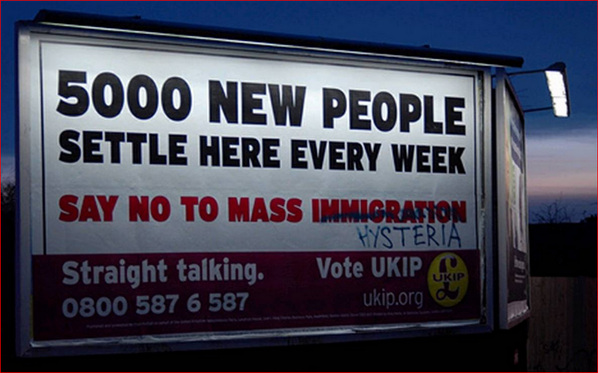
    Somewhere out there in the UK, someone is taking a spray can to UKIP’s xenophobic European Parliament election campaign posters.

    UKIP poster amended to read No to Mass Hysteria

    Hat tip: Maria Aretoulaki

    Incidentally, if you get a UKIP election leaflet and you don’t wish to pollute your paper recycling with it, you can return it free of charge to them at the following address:

    UKIP FREEPOST
    RLSU-HZBG-UBBG
    Lexdrum House
    Heathfield
    Devon
    TQ12 6UT

Posts navigation