language

  • Ebook manager Calibre reaches version 1.0

    Ebook management software Calibre has now reached version 1.0, seven years after it was first released and a year since the last major release. Lots of new features have been added to calibre in the last year — a grid view of book covers, a new, faster database backend, the ability to convert Microsoft Word files, tools to make changes to ebooks without needing to do a full conversion, full support for font embedding and sub-setting, and many more, which are listed below. However, it should be pointed out that many of the features listed below were actually introduced during the lifetime of Calibre’s 0.9.x series.

    • A grid view of book covers
    • A new, faster database backend
    • Virtual Libraries
    • Conversion of Microsoft Word documents (.docx files)
    • New metadata download sources
    • Full support for font embedding
    • An easy to use tool to edit the Table of Contents in ebooks
    • Rewritten PDF output engine
    • New “Polish books” tool that allows users to carry out various automated clean-up actions on ebooks

    image of calibre interface

    The developers of Calibre also believe now is an appropriate time to express their thanks to all the developers who have contributed many of the major new features listed above. An incomplete list of contributors is available here.

    Calibre 1.0 is now available for download for Linux, MacOS and Windows.

  • Sibling Saunter 2013 – walking with Wild Eadric and Offa

    Yesterday I returned from my annual meet-up in Shropshire with my sister Hilary. Dubbed the ‘sibling saunter’, it’s an opportunity we take each year to meet in Shropshire, the county of our birth, and go walking without the encumbrance of children, partners, etc.

    This year we went down into the Clun area in the south-west of Shropshire and the first day’s walk took us into Wales. Following an excellent route map (PDF) prepared by the Clwyd-Powys Archaeological Trust, we visited the prehistoric burial cairns on Corndon Hill (513 m above sea level) before making to the Miner’s Arms in Priestweston for a pint and finishing off at the Mitchell’s Fold stone circle. Legend has it that one of the stones in the circle is a petrified witch, punished by locals for seeing off a magic cow that provided them with unending supplies of milk.

    There’s a very convenient bench next to the trig point on the top of Corndon Hill and it’s perfect for a breather and a refreshment stop.

    Just south of Corndon Hill is a small outcrop of a volcanic rock known as picrite. This was used to make stone axes at around the same time that the burial cairns and stone circle were constructed. CPAT has investigated this prehistoric quarry, also known as Cwm Mawr.

    Mitchell's Fold
    A breather at Mitchell’s Fold

    The porous, unclear nature of the border between England and Wales is well evidenced around this area by places with English names in Wales and Welsh ones in England. The border itself has moved around too. For instance, Montgomery – the site of one of the Marcher castles and now firmly part of Wales – is included in the Shropshire county returns of the Domesday Book.

    Although our Corndon Hill walk was only 6 miles in length, we both agreed on its strenuous nature for fifty-somethings, albeit fairly fit ones.

    As the first evening of our annual saunter set in, we were still undecided as to the next day’s walking route. Eventually we decided on a loop of some 10 miles in length comprising a section of the Shropshire Way to Hergan and its junction with the Offa’s Dyke Path, which here is well preserved and follows the line of the Dyke itself, down to Newcastle on Clun and then back to our base at the youth hostel in Clun.

    Offa’s Dyke is a massive linear earthwork, roughly followed by some of current border between England and Wales. In places, it is up to 19.8 m wide – including its flanking ditch – and 2.4 m high, with the ditch always on the Welsh side. In the 8th century it formed some kind of delineation between the Saxon kingdom of Mercia and the Welsh. Offa himself was King of Mercia from 757 to 796.

    So we set out from the grounds of Clun Castle following the Shropshire Way along the valley of the River Clun. The route is well waymarked and the Shropshire Way’s buzzard logo is well displayed on all signposts. After a couple of miles we climbed over the Cefns to Hengarn and Offa’s Dyke.

    The junction of Offa's Dyke (on the left) and the Shropshire Way (on the right)
    My sister, the great navigator, at the junction of Offa’s Dyke (on the left) and the Shropshire Way (on the right)

    The section of the Shropshire Way over which we’d walked was shared with Wild Eadric’s Way, named after Eadric the Wild, a Saxon thegn (or thane. Ed.) who was lord of Clun and refused to swear fealty to the usurping William the Bastard of Normandy. The factual life of Eadric has since become interspersed with folklore, as shown in this article.

    But back to Offa’s Dyke. The section we were walking is amongst the best preserved that remains. Furthermore, whilst descending to Newcastle on Clun, we passed the halfway point between the path’s 2 end points – Chepstow and Prestatyn. It was most fortunate we were walking on a Wednesday as there’s a community café open in Newcastle’s community centre on Wednesdays between 10.30 am and 4.30 pm; the refreshments were excellent! I recommend the ginger and lemon cake.

    Once back in Clun it was time for a well-earned pint in the Sun Inn before retiring back to the youth hostel. If you’re thinking of staying in the area and have fond memories of ‘old skool’ hostelling, you’ll love Clun YH. It’s a beautifully restored water mill with plenty of the mill machinery on view. Furthermore, it’s one of those hostels where people talk to one another. Before drawing to a close, I’d like to thank Sue the volunteer warden on duty during our stay for her helpfulness and very cheery disposition. We both hope the bedding inventory didn’t do your head in! 🙂

    We’re taking the sibling saunter back to the Clun and Bishops Castle area next year to explore inter alia the Iron Age hill fort of Bury Ditches.

    Update: 24/08/13: About the time this post was published yesterday, the Shropshire Star reported that a section of Offa’s Dyke in Wales has been destroyed by bulldozer. Police and Cadw, the Welsh heritage organisation, are continuing to investigate how the earthwork alongside the A5 north of Chirk, came to be flattened in this blatant act of vandalism. Jim Saunders of the Offa’s Dyke Association is reported to have said: “The ditch could be dug out but the dyke has been destroyed now it will never be the same again.”

  • Would you buy a used Capita T&I?

    According to company financial information website DueDil, Capita Translation & Interpreting, the company that has been entrusted (rather foolishly. Ed.) by the Ministry of Justice with providing interpreting services for courts and tribunals in England and Wales (posts passim), is not doing particularly well financially, as the screenshot of the company’s latest basic financial information shows.

    screenshot of Capita T&I financial data
    Click on the image for the full-sized version

    Would you buy this company or offer it more work?

    Answers in the comments please!

  • Home Office’s racist van investigated by ASA

    Yahoo News reports that the Advertising Standards Authority (ASA) is investigating the recent Home Office poster van campaign targeting immigrants and dubbed the ‘racist van’ due to the crass insensitivity that is a hallmark of the Whitehall PR machine nowadays (posts passim).

    image of billboard van showing Home Office's anti-immigration message

    The ASA has so far received 60 complaints expressing concerns that the advertisements were “reminiscent of slogans used by racist groups to attack immigrants in the past”.

    The racist van was driven around the London boroughs of Barnet, Hounslow, Barking & Dagenham, Ealing, Brent and Redbridge – all areas with a high percentage of ethnic minority residents – as part of a £10,000 Home Office pilot scheme, which ended at the end of July.

    As a counterpart to the Home Office’s mobile billboard, human rights and civil liberties organisation Liberty drove its own ‘anti-racist van’ around the streets of the metropolis.

    Liberty's anti-racist van

  • Ask Crapita awkward questions, lose work

    Reposted from Linguist Lounge.

    On Wednesday, 7th August 2013, Hammrammr wrote:

    Some time ago Capita TI implemented the so called JSA – new contract which was rather unclear and detrimental to interpreters. After several weeks of wrangling with their completely untrained workers I managed to get hold of someone dealing with legal matters. I forwarded several emails regarding inconsistencies and unclear issues within that ‘document’. Finally I received a rather short message that their legal team acknowledges my concerns and I can basically get lost. My concerns were not only about insurance but focused on special deals granted to a small group of Polish interpreter at Westminster MC. My further enquiries resulted in a message from an individual calling himself Commercial Manager at Capita HQ, that my profile was deactivated, which means that they do need my services any longer as they have now enough docile, new breed of ‘interpreters’. They are not going to grant any special, ‘bespoke’ contracts to anyone else.

    Conclusion: As this “de facto employment” agency enjoys a monopoly in the CJS sector of interpreting they became a law unto themselves – arrogant, abusive and biased. Such action basically barred me from working in the courts. I conducted another survey focused on awareness of various court staff regarding the use of interpreters without middlemen. I called and/or visited 14 courts in Northern and SW areas of England. The same reaction: from disinterested, to onward hostile. Most of relevant court employees were not even aware that FWA is not a closed shop and they are allowed to use other methods of booking interpreters. Some of them mentioned that such a decision is outside their remit, each case to be authorised by their court manager. Several still keep their own records and book proper interpreters when and if required though.

    Let us hope that so called FWA is terminated sooner or later. I am going to seek legal advice from an employment law specialist in order to enter legal proceedings in the future.

  • Bristol Post Balls – let it rain

    Certain parts of the country suffered from very heavy rain earlier this week. Where I was camping in the Black Mountains for the past week, we had some 3 inches of rain over the weekend.

    image of a row of umbrellas
    Image courtesy of Wikimedia Commons

    The Bristol area was also affected by the torrential downpour. Sit back and marvel at the mathematical genius of an anonymous Bristol Post reporter in this report posted in the online version on Sunday and bearing the headline “Met Office issues severe weather warning as Bristol poised for 12 hours of heavy rain“.

    The forecast is for heavy rain from 10pm tonight, stretching through until 10pm on Monday, before heavy rain showers persist until 7pm.

    Excluding the heavy showers, I make that at least 24 hours. How about you? 🙂

  • Sea greens

    Yesterday I left the confines of Bristol and travelled down to the Bristol Channel coast.

    While there I was there I made time to visit an area of salt marsh to forage for marsh samphire (also known as glasswort), which is currently in the midst of its short season, which consists of the months of July and August only.

    image of marsh samphire
    Marsh samphire (Salicornia europaea)

    Samphire can be eaten raw or cooked. In the latter instance, no salt needs to be added to the cooking water as the plant has an inherent high salt content. It has a fresh, salty taste, crisp texture and makes a great accompaniment to fish and shellfish dishes, eggs or such specialities as salt marsh lamb. As samphire gets older and larger, the core of the plant becomes more stringy and the succulent flesh has to be stripped off the stringy core.

    Until the start of the 19th century, marsh samphire also had industrial uses: before the introduction of the LeBlanc process for the industrial production of soda ash, marsh samphire ashes were long used as a source of soda ash (mainly sodium carbonate) for making glass and soap.

    As regards the origin of the noun samphire, it is believed to be a corruption of the French name herbe de Saint-Pierre, i.e. “St Peter’s herb”.

  • Bristol Post Balls 4 – a classic homophone

    Today’s cock-up by the Bristol Post, from a story entitled ‘Man on lilo rescued after drifting out to sea off Weston-super-Mare’, has gained Bristol’s newspaper of record a seat in homophone corner.

    For the benefit of passing Post journalists a homophone is “a word that is pronounced the same as another word but differs in meaning. The words may be spelled the same, such as rose (flower) and rose (past tense of “rise”), or differently, such as carat, caret, and carrot, or to, two, and too.”

    Now let’s see (or sea. Ed.) what landed the Post this particular accolade.

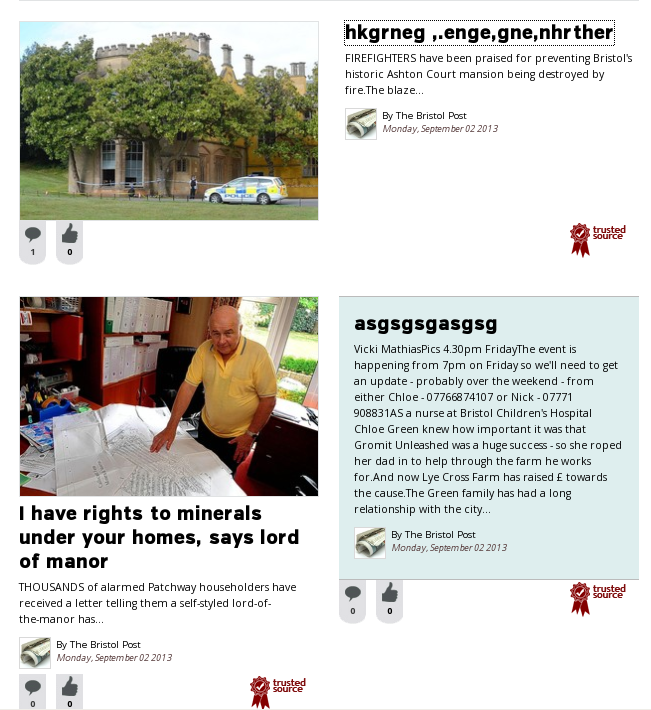
    screenshot of homophone from Bristol Post
    What did he drift out to see, Bristol Post?
Posts navigation