Steve Woods

Generic carbon-based humanoid life form.

  • Free Windows clone ReactOS needs support

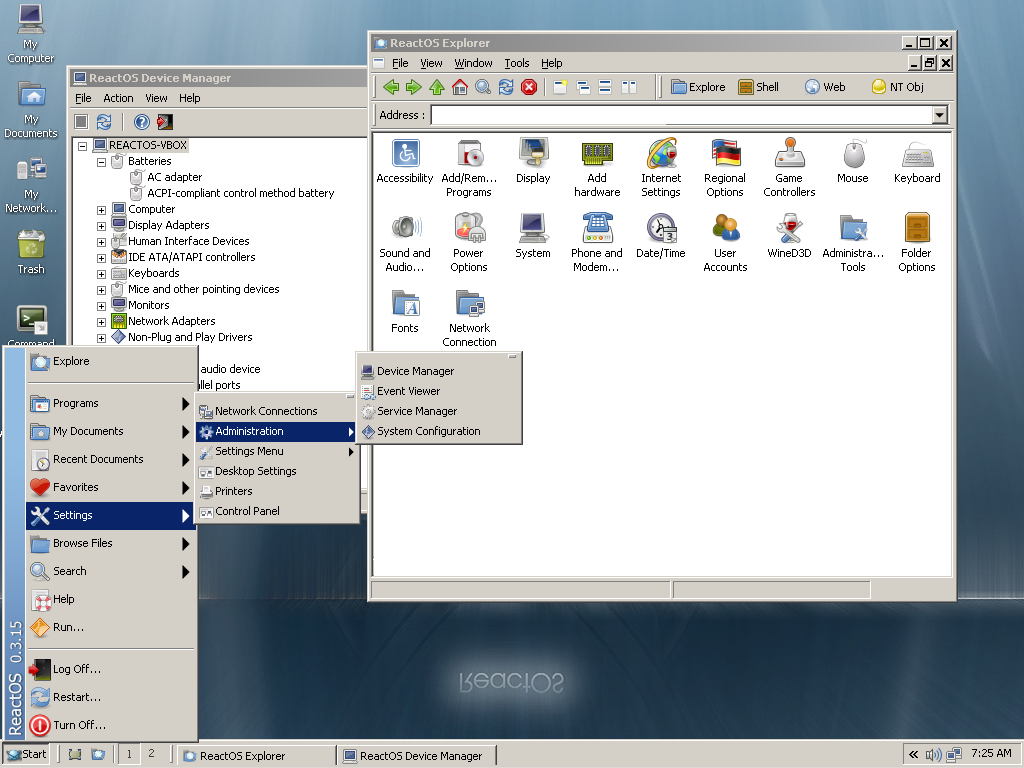
    German IT news website Heise writes that the developers of ReactOS, the free and open source Windows clone, have launched a Kickstarter campaign to advance the development of their Windows-compatible operating system. The campaign’s target is to collect $120,000 for the development of a commercial version of ReactOS called “Thorium Core”. The developers state that everything which is developed in Thorium will also be fed back into ReactOS. The Kickstarter campaign will run until 21st February and had realised over $18,000 at the time of writing.

    screenshot of ReactOS
    ReactOS screenshot. Image courtesy of Wikimedia Commons.

    The ReactOS project has the aim of building an open source operating system based on Windows NT architecture with a Win32 sub-system. The current development aim is compatibility with Windows NT 5.2, so that 32 bit hardware drivers and applications for Windows XP (NT 5.1) and Windows Server 2003 (NT 5.2) can be used. Finally, ReactOS should provide a leaner and more flexible environment for Windows applications than that provided by current versions of Windows. Nevertheless, the developers warn that the most recent version of ReactOS – 0.3.15 – is still an alpha version and advise against using it for day-to-day work.

  • Clueless Crapita tweets its ignorance

    This blog has drawn attention before to the lamentable lack of knowledge of certain bodies, e.g. the BBC and various newspapers, to the difference between translating and interpreting.

    As the screenshot below shows, these bodies have now been joined by Capita Translation & Interpreting, that arm of the Crapita empire which is busy wasting public money by failing to provide interpreters – or those of good enough quality – for courts and tribunals under a contract with the Ministry of Justice (posts passim).

    screenshot of exchange of tweets on Twitter

    This exchange came into my Twitter timeline on the same day as the Law Gazette reports that Capita T&I has never managed to reach its 98% performance target under its Framework Agreement with the Ministry of Justice in the 2 years it has held the contract and just a few days before Ursula Brennan, Permanent Secretary at the MoJ, is due to appear before the House of Commons’ Public Accounts Committee as they examine the interpreting contract for a second time (posts passim).

    As the Crapitards in charge of the Capita T&I are clearly confused by the difference between translators and interpreters, I can only recommend they too read my illustrated guide post.

  • Bristol Post Balls – an American in Bristol

    There’s some bloke called Brendan Cole off something called Strictly Come Dancing on the television that’s currently got a show on at Bristol’s Hippodrome called ‘Licence to Thrill’, as shown by the publicity featured below.

    cole

    Earlier today the Bristol Post’s review of the show featured a translation of the show’s title into American English, no doubt in a bid to help transatlantic visitors to Bristol (alternatively, it could have been caused by letting an American intern loose in the news room or a keyboard/software configuration cock-up. Ed.), as shown by the following screenshot.

    Bristol Post headline with US spelling license

    The spelling of the headline has since been corrected.

    Y’all have a nice day! 🙂

  • Cambridge City Council confused by apostrophes, so bans them!

    Last year Mid Devon District Council took the daft and ungrammatical decision to ban the use of apostrophes – and other punctuation – in street signs (posts passim).

    Mid Devon’s decision was justified by the pathetic excuse that removing punctuation was to “avoid confusion”.

    This same line is now being trotted out by Cambridge City Council, in whose hallowed halls the city’s reputation for learning and scholarship appears has lost a battle with the dead hand of bureaucracy, as the Cambridge News reported on Friday.

    According to the Cambridge News

    Officers said they were following national guidance which warned apostrophes could lead to mistakes, particularly for emergency services.

    image of Hobson's Conduit Cambridge
    Hobson’s Conduit. Soon to be Hobsons Conduit courtesy of Cambridge City Council?

    Needless to say, with such a high profile city, the move has been criticised by language experts.

    Quoted in the Daily Telegraph, Kathy Salaman, Director of the Cambridge-based Good Grammar Company said:

    I know some people think apostrophes are superfluous but we really need them and I think it’s the first step on a slippery slope.

    If councils are getting rid of them, what kind of message does that give out to students at schools?

    Dropping apostrophes is pandering to the lowest denominator and while eradicating them anywhere is dreadful, it is particularly bad to do it in Cambridge.

    Quite.

    One must wonder what kind of English language teaching the officers of Cambridge City Council underwent at school, particularly since according to the British Council‘s grammar reference for people learning English, the rules for the use of apostrophes are “very simple”.

    The British Council’s advice on using apostrophes is reproduced below for any passing council officers with responsibility for road and street signs.

    Apostrophes
    We use an apostrophe (‘) to show either possession or that there is a letter missing (e.g. the apostrophe in ‘she’s’ shows that there is a letter missing in ‘she is’)

    We use apostrophes with people or animals to show possession.

    • My sister’s house.
    • The dog’s blanket.

    For things we use ‘of’ (the front of the car, NOT the car’s front.)

    The position of the apostrophe depends on whether the noun is singular or plural. look at these two examples.

    • My friend’s house. This is about one friend.
    • My friends’ house. This is about two or more friends who share a house.

    If a plural noun does not end in ‘s’ (e.g. men, people, children) we use ‘s to show possession.

    • The children’s bedroom.
    • A pair of women’s sunglasses.

    We also use an apostrophe in some time expressions.

    • two weeks’ holiday
    • ten years’ experience

    If people are really getting confused by apostrophes, doesn’t this indicate that English language teaching – particularly that related to punctuation – needs to be improved? After all, banning something you don’t understand is the action of a philistine.

  • MoJ up before the PAC again

    The House of Commons’ Public Accounts Committee is keeping up the pressure on the Ministry of Justice over its disastrous courts and tribunals interpreting service with Capita Translation & Interpreting.

    On Monday 27 January 2014 the Committee has summoned the MoJ’s Permanent Secretary, Ursula Brennan, to give evidence on ‘Interpreter services’, as shown by the following extract from the Parliamentary business calendar.

    3.15pm Public Accounts

    Subject: Treasury Minutes follow-up (i) Severance payments (ii) Interpreter services (iii) Rural broadband
    Witness(es): Una O’Brien, Permanent Secretary, Department of Health, Sir David Nicholson KCB CBE, Chief Executive, NHS England and Mark Sedwill, Permanent Secretary, Home Office; Ursula Brennan, Permanent Secretary, Ministry of Justice; Sue Owen, Permanent Secretary, Department for Culture, Media and Sport and Jon Zeff, Director and Programme Senior Responsible Office, Department for Culture, Media and Sport

    In the Committee’s previous examination of interpreter services in 2012 neither the MoJ nor Capita exactly came away unscathed. On publication of its subsequent report, Committee Chair Margaret Hodge MP was scathing about the way the MoJ had managed the placing of its contract (posts passim), saying: “This is an object lesson in how not to contract out a public service.”

    As for Ursula, her Civil Service biography on the MoJ’s website linked to above informs us that she spent most of her career in what is now the Department for Work and Pensions (DWP). While there one of the areas in which she was involved was fraud (in that instance benefit fraud. Ed.). Evidence to date would tend to suggest that she is having difficulty finding it under her nose in her present department.

    Update 26/1/14: Ursula Brennan will not now be appearing for the Ministry of Justice to assist the PAC with its continuing investigation of court interpreting; she has been replaced by Ann Beasley, Director-General of Finance at the Ministry of Justice and Peter Handcock CBE, Chief Executive of Her Majesty’s Court and Tribunal Service (HMCTS).

    This is the third time Ursula Brennan has been due to appear before the PAC and has found something to do instead. One might get the impression she is frightened of Margaret Hodge et al., but I couldn’t possibly comment on that! 🙂

    Hat tip: Louise Gough for the update.

  • More trouble with Capita Vietnamese interpreters

    Our friends at Capita seem to be having a bit of bother recently with a dearth of Vietnamese interpreters (posts passim).

    On 10th January, I.V., a solicitor wrote the following post on RPSI Linguist Lounge.

    I was a duty solicitor on Tuesday night we were instructed on a cannabis factory case. Due to the co-accused giving an age the police did not believe we weren’t interviewed until mid afternoon. A decent interpreter turned up on time (credit where credit due).

    To the surprise of my rep our client and the “youngster” were charged and RIC. I am fortunate to have a Vietnamese member of staff so she came in to see him with me. No police booked interpreter attended and at lunchtime despite many requests the court finally looked in to it. They booked Capita at 2 – the use of my interpreter for the case was discounted. No interpreter attended and at 2 pm with no idea of what was happening the pair were remanded to today.

    The youth was taken to a detention centre and my client to Winson Green – an adult prison!! He is 18. Last night the court clerk in our hearing booked a new interpreter. None has arrived and despite conflicting stories we are now told none has been booked. The DJ has decided that should my interpreter be present this afternoon then a pragmatic approach may be taken. So all day yesterday much of today all for me for the mileage!! Of course we did nothing to help!!!

    We went to the crown court as I ascertained that a trial was taking place there with a Vietnamese interpreter. No, can’t use her. The 2 people in custody are highly confused and both allocated to incorrect institutions. Mine has already tried to dispense with my services. Luckily the approached solicitor on realising someone else instructed withdrew and let me know. This is how I make £’0000’s a year!!

    We used my interpreter in the end.

  • Wikipedia community votes on MP4

    Wikimedia Commons logoContent on Wikipedia should not only be made available under a free licence, but also in free formats. As this is associated with limitations the Wikimedia multimedia team has launched a request for comment to integrate the H.264 MP4 codec, Heise reports.

    Such proprietary codecs have so far not been allowed in Wikipedia and its sister projects; even MP3 files are not allowed. Videos can only be uploaded in Ogg Theora format and the open WebM format developed by Google.

    In the opinion of the multimedia team, this limitation is significantly preventing the use of videos. Although the Chrome and Firefox browsers can play WebM, other browsers have still not implemented the format. It looks even worse as regards mobile devices: according to an analysis, two-thirds of mobile calls to Wikimedia servers originate from devices which cannot play the video formats made available on Wikipedia. Even the uploading of videos is made more difficult since contributors must first convert their videos before they can upload them. The result is that only 38,000 videos can be found on the Wikimedia Commons multimedia platform, whereas YouTube makes 6.5 million videos available in the education category.

    The proposal is not meeting with much approval in the community. On the first day of the discussion which started a month ago, must users spoke out against any support for MP4; however, supporters are not occupying too inferior a position. In particular, the secret licence agreements and any licensing payment due for commercial use of videos are being criticised. A compromise in which the Wikimedia Foundation will convert all uploaded MP4 videos into open formats is only supported by very few contributors.

    The multimedia team must now put more effort into convincing people if it wants to convert its plans into reality. Heise says the Wikimedia Foundation is adopting a neutral official position.

  • How to write user help

    A product’s user guide or help is an essential element of most items of software or consumer products today.

    Well-written help can save hours of confusion and frustration as new users get to grips with tools. It should be concisely written but cover all aspects of the use of the software or product.

    The wavemon program for Linux is a monitor for wireless devices. It allows users to watch the signal and noise levels, packet statistics, device configuration and network parameters of their wireless network hardware.

    Here’s wavemon’s help file.

    screenshot of wavemon help file

    Concise isn’t it?

  • UK’s CESG finds Ubuntu most secure OS

    Ubuntu logoUbuntu 12.04 LTS proved to be the most secure product in a client operating system investigation by British security body Communications Electronics Security Group (CESG), which is part of GCHQ and provides assistance to government departments on their own communications security, according to a report today in Germany’s Linux-Magazin.

    The test field consisted of 11 desktop and mobile operating systems, including Windows 7 and 8, Windows RT, Android 4.2, Apple’s iOS 6 and Mac OS X 10.8, as well as Google Chrome OS 26. CESG investigated the security of the systems in various categories, e.g. VPN, hard drive encryption, secure boot, sandboxing, implementation of security policy and update policy.

    No system was able to meet all demands for use by the British authorities, but Ubuntu 12.04 LTS was shown to be the most secure system of those tested. Windows Phone 8 has the most critical vulnerabilities.

    Ubuntu supplier Canonical has summarised the results as it sees them in a PDF. The company is hoping to do even better with the forthcoming Ubuntu 14.0 LTS version of its operating system, particularly by supporting secure boot.

    More detailed information about the test is available on the CESG website, including CESG’s Ubuntu-specific report.

    First published by Bristol Wireless.

  • Italy puts free software first in public sector

    The Italian government has made free software the default choice for public sector organisations, the Free Software Foundation Europe (FSFE) reports. In a document (PDF, Italian) published last Wednesday, the Italian Digital Agency (Agenzia per l’Italia Digitale) issued rules saying that all the country’s government organisations must consider using free software before buying licences for proprietary programs.

    logo of Italian Digital Agency
    Logo of Italian Digital Agency

    The document, “Guidelines on comparative evaluation [of software]”, sets out a detailed method which public bodies must follow when deciding which software to use. They are required to look for suitable free software programs or choose software developed by the public sector. They may only consider procuring proprietary software no suitable programs of these types are available.

    “There is no excuse. All public administrations must opt for free software or re-use whenever possible”, says FSFE General Counsel Carlo Piana, who was part of the committee that advised on the guideline. “Now free software and re-use are the norm, proprietary software the exception. This is the most advanced affirmative action in Europe so far. I’m so proud that Italy leads the way, for once”.

    The document was authored by the Italian Digital Agency, which for the first time consulted representatives from the public sector, the free software community, and proprietary software makers.

    Importantly, the new rules come with a mechanism to ensure they are followed. Both public bodies and members of the public can ask the Italian Digital Agency to check if a given organisation is following the correct procedure. Administrative courts can annul decisions that contravene these rules and, in the event of negligence, individual public servants may be held personally liable.

Posts navigation