Steve Woods

Written by a human.

  • Spiritual leader moonlights as police officer

    Reading the captions on photographs in the local press can be a real education.

    For instance, thanks to those dedicated people who write captions for articles on the Bristol Post website, I now know what a branch of discount retailer Lidl looks like, although I shall have to travel to Paignton to see the real thing.

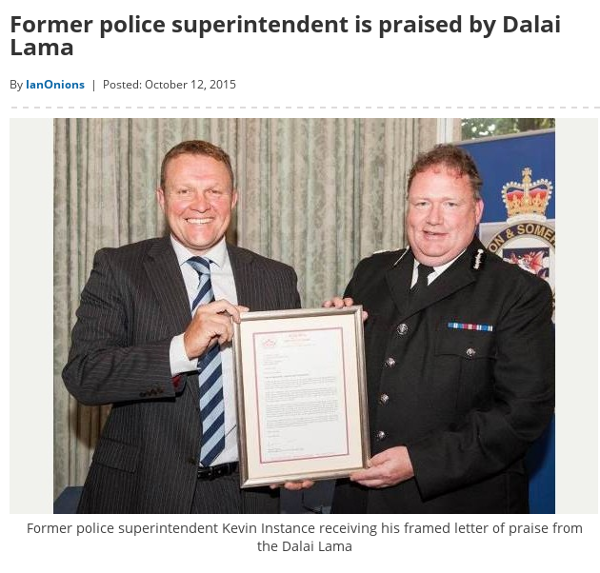
    However, far greater secrets can be revealed by photo captions. An article in yesterday’s Bristol Post revealed that, unknown to the rest of the world, His Holiness the 14th Dalai Lama, is actually a police officer in Avon & Somerset Constabulary, as shown by the following screenshot.

    caption on image reads Former police superintendent Kevin Instance receiving his framed letter of praise from the Dalai Lama

    His Holiness must have found some body-altering drugs during his recent visit to the Glastonbury Festival! 😉

  • Bristol’s rudest place name?

    The other night conversation down the pub turned to Bristol place names.

    Wherever one is, place names give a locality character. They commemorate local personalities, such as Mary Carpenter Place in Bristol’s St Pauls area, as well as national figures, e.g. Nelson Parade in Bedminster.

    Others were named after the trades practised or goods traded on them. Bristol used to have a Milk Street and a Cheese Lane; it still has a Wine Street and a Corn Street, together with Old Bread Street.

    Some street names are stranger and Bristol does not disappoint here either. There’s Zed Alley in the city centre, along with Counterslip down by the floating harbour. Counterslip is a corruption of Countess’ slipway, a reference to one of the long-vanished amenities on the then tidal River Avon of Bristol’s long-demolished castle.
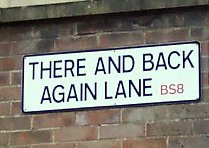
    road sign for There And Back Again LaneHowever, odd street names are not confined to Bristol’s centre. Up in Clifton one can find There and Back Again Lane, whose signs are a favourite target for the larcenous intentions of drunken student. Just beyond Durdham Downs, towards Stoke Bishop, is Pitch and Pay Lane. The origins of the lane’s name apparently hark back to times of plague when goods and money would be exchanged by being thrown across the thoroughfare.

    Besides food and drink, other bodily needs are also commemorated. Along with other medieval towns and cities, once boasted a Grope Lane – to use the polite version – where ladies of negotiable affection were purported to ply their trade. The earliest written reference to Bristol’s Grope Lane I’ve found relates to 1433. It was previously known as Halliers Lane. Nowadays it’s better known as Nelson Street.

    Besides streets and roads, fields also have names: and it is to one of these that one has to turn to find Bristol’s rudest place name – Fockynggroue.

    Below is part of the abstract of a paper by linguistics professor Richard Coates of the University of the West of England (UWE):

    The lost field-name Fockynggroue is recorded in the perambulation which constitutes the bulk of a Bristol charter conjecturally of 30 September (inspeximus 30 October), 47 Edward III, that is 1373. This document was drawn up when Bristol was granted county status.1 The field was in the region north(-west) of Brandon Hill between locations identifiable in modern times as Woodwell Lane and Crescent (names now lost, near and in St George’s Road) and Cantock’s Close.2 A. H. Smith, the editor of The Place-Names of Gloucestershire, offered no explanation, although he had obviously reflected on it because he classified it in the element-index as containing a ‘significant word’ (i.e. not a personal name), but without further elaboration.3 Perhaps he thought it too risqué to dwell on or too obvious to deserve comment, but, if so, he omitted to address a consequent issue in the lexical history of English. He did not cite the additional forms given in Bristol Charters.4 These are taken from perambulations of the city boundaries taken between the granting of county status and 1901: ‘Fukkyngroue, Pocking, Fokeing, Foking or Pucking Grove’. The name certainly lasted till around 1900, when a printed abstract of title for Hither & Inner Pucking Grove from 1707–1842 and a sale agreement of 1899 for the place were in existence.5

    In modern times Fockynggroue has been diverted from its past as a location of carnal pleasures. Where it once helped generations of locals enjoy loving trysts and the pleasures of the flesh, it now caters for the intellect, having been built over as part of the campus of the University of Bristol.
  • A world without Linux – episode 1

    Below is the first of what will a series of videos seeking to depict what the world would be like had Linus Torvalds not released his kernel 24 years ago, with that kernel then being combined with the tools produced by the GNU project to create a powerful and reliable operating system.

    A World Without Linux is a web series that flips this reality on its head to illustrate entertainingly just how pervasive Linux is today.

    The video itself reminds your correspondent of how much time he used to spend doing work research in reference libraries before the advent of the internet: now the internet comes to him, which is much more convenient. 🙂

    Linux is the world’s largest collaborative project in the history of computing. It runs most of the world’s technology infrastructure and is supported by more developers and companies than any other platform. It’s everywhere – from your phone to your car and your office. It also powers the internet, the cloud, the world’s stock exchanges, supercomputers, embedded devices and more.

    Reposted from Bristol Wireless.

  • Linux kernel is 24 years young on Monday

    Although Linus Torvalds, the originator of the Linux kernel, announced his initial work on the kernel on 25th August 1991, it was not until 5th October 1991 that Linus actually released his code: Linux kernel 0.01.

    Linus Torvalds gives a photographer the finger
    Linus Torvalds in combative mood

    With this October anniversary in mind, it’s worth taking a bit of time to review what’s changed to the kernel over the intervening years.

    Version 0.01 of the kernel had 10,293 lines of code. In contrast, version 4.1, released in July 2015, has more than 19 million lines of code, according to Phoronix. That’s quite spectacular!

    The current Linux kernel is the result of one of the largest collaborative projects ever attempted and since tracking began 10 years ago, more than 10,000 developers working from more than 1,200 companies have contributed to the kernel.

    Furthermore, the speed of Linux kernel development is breathtaking. The average number of changes accepted into the kernel per hour is 7.71, equivalent to 185 changes every day and nearly 1,300 per week.

    This rapid development and collaboration have been a spur to others. Writing yesterday on the Linux Foundation blog, Jennifer Cloer states: “In recent years, the powerful growth of the Linux kernel and resulting innovation has inspired others to adapt the principles, practices and methodologies that makes Linux so successful to solve some of today’s most complex technology problems,” and, “We’ve learned so much from Linux and have no doubt that learning will continue.”

    Originally posted on Bristol Wireless.

  • ODF is a “financial and social responsibility”

    ODF logoThe Dutch government wants to accelerate the adoption of Open Document Format by the country’s public sector according to a press release by the government’s Standardisation Board.

    On behalf of the government, the Standardisation Board is determined to speed up ODF’s adoption throughout the government.

    This was one of the most important announcements made at the 11th ODF Plugfest held in The Hague, where a group of international developers, EU policy-makers, digital archivists, academics and other experts assembled to discuss the Open Document Format, an XML-based file format for spreadsheets, charts, presentations and word processing documents that was developed with the aim of providing an open, XML-based file format specification for office applications.

    “In view of its extent, the public sector is an important stakeholder when a sound future for office applications is involved”, says Steven Luitjens, the director of Logius, the largest operational IT organisation within the Dutch government. “It is our financial and social responsibility to bring about an improvement. We are therefore increasing our efforts in the Netherlands. We want to play an important role in the huge transition from commercial productivity packages to better, bespoke solutions based on open standards which lies ahead of governments and the private sector.”

    ODF is top priority

    “The need to adopt ODF speaks for itself,” says Nico Westpalm van Hoorn, Chairman of the Standardisation Board, which is concerned with the choice of IT standards for the government. “However, the adoption is proceeding too slowly. ODF is therefore out top priority”.

  • Community pick litter in Barton Hill

    There have been some unkind words on social media that all Tidy BS5 campaigners do is moan about the cleanliness of Bristol’s Easton and Lawrence Hill wards on social media.

    Yesterday those words were once again proved to be a lie (posts passim).

    A photo call break during the pick.
    A photo call break during the pick. Picture courtesy of Up Our Street.

    In brilliant sunshine a dozen or so volunteers turned up in Barton Hill Urban Park to clear away litter and rubbish. Those volunteers included local residents who saw what was going on and joined in. Others of all ages from those in primary school to pensioners expressed their support.

    Bags for collecting the litter were kindly provided by Keep Bristol Tidy, the accumulated litter removed over the weekend by Bristol City Council, whilst the event itself was co-ordinated by Up Our Street.

    Amongst those volunteers were local ward councillors Marg Hickman and Afzal Shah, both of whom have been invaluable supporters of the Tidy BS5 campaign.

    Barton Hill Urban Park is just in Lawrence Hill ward, with its boundary abutting the dividing line with Easton ward.

    The next community litter pick to be organised locally will be held on Saturday, 7th November between 11.00 am and 1.00 pm, with the assembly point being the car park of Masala Bazaar, 382-386, Stapleton Road, Easton, BS5 6NQ (map).

  • LibreOffice 5.0.2 announced at LibreOffice Conference

    To underline the importance of the event for the community, The Document Foundation (TDF) has today announced the release of LibreOffice 5.0.2 during the opening session of the 2015 LibreOffice Conference in Aarhus, which runs until Friday 25th September.

    LibreOffice 5.0.2 is the second minor release of the LibreOffice 5.0 family, with a large number of fixes over the first minor (5.0.1) release announced in August. Based on feedback from the marketplace, the LibreOffice 5.0 family has so far proved the most popular LibreOffice release ever.

    LibreOffice 5

    LibreOffice 5.02 will offer OpenGL rendering by default on Windows for the first time for those with the very latest Windows drivers. In the event of problems, this functionality is easy to disable by accessing Tools > Options.

    LibreOffice 5.0.2 is aimed at technology enthusiasts, early adopters and power users. For more conservative users and for enterprise deployments, TDF recommends the “still” version: LibreOffice 4.4.5. For commercial deployments, The Document Foundation recommends the backing of professional support by certified people.

    People interested in technical details about the release can access the change logs via the following links: bugs fixed in RC1 and bugs fixed in RC2.

    LibreOffice 5.0.2 is available for immediate download from http://www.libreoffice.org/download/.

  • FSFE elects new top officials

    FSFE logoMatthias Kirschner and Alessandro Rubini are the new President and Vice-President respectively of the Free Software Foundation Europe (FSFE). They were elected last week in Bucharest during FSFE’s General Assembly, while Reinhard Müller was re-elected as Financial Officer. They will serve FSFE in those capacities for the next 2 years.

    Matthias Kirschner has been an FSFE employee since 2009. He started using GNU/Linux in 1999 and realised that software is deeply involved in all aspects of our lives. Matthias is convinced that this technology has to empower society rather than restrict it. While studying Political and Administrative Science, he convinced the FSFE to accept him as its first intern in 2004. Since then he has been helping other organisations, companies and governments to understand how they can benefit from Free Software and how those rights help to support freedom of speech, freedom of the press and privacy.

    Alessandro Rubini is an electronic engineer and holds a Ph.D. in computer science. He was an early Linux adopter, installing Linux 0.99.14, is an active Free Software user and developer, and author of the book “Linux Device Drivers”. After his doctorate, he left the university as he did not want to just write academic papers and now works as an independent consultant in the industrial use of GNU/Linux, mainly on device drivers and embedded system as well as on micro-controllers and PCB design. Recently he has been working with CERN within the White Rabbit project, aimed at sub-nanosecond synchronisation of I/O cards. One reason he enjoys working with CERN is the organisation’s policy of releasing all their work as Free Software and Free Hardware.

    Alessandro was previously a member of the Free Software Foundation Europe from 2001 to 2006 and recently rejoined. He felt that FSFE is the right place for positive and constructive discussions about Free Software.

    “I am happy to welcome both Matthias and Alessandro to their new roles,” says Executive Director Jonas Öberg, “both have been instrumental in shaping the organisation into its current form and I look forward to the expertise they will bring as we go about empowering users to control technology.”

    Reposted from Bristol Wireless.

  • Dump the Mayor

    It would appear that the communities of South Bristol are also getting fed up with fly-tipping too and want the long-promised Hartcliffe recycling centre opened as they believe it could help cure this local environmental blight.

    Local campaigners have now made a video to assist their efforts in securing this much-needed facility (at present Bristol has 2 main council-run recycling facilities, both north of the River Avon and miles away from Hartcliffe. Ed.)

    However, there is one obstacle in their way: the opposition of Mayor George Ferguson.

    One would have thought that with the amount of waste produced by the city increasing and recycling rates declining, Bristol’s most senior elected official would leap at any chance of reversing this during Bristol’s year as the alleged European Green Capital, but it seems like he refuses to do anything at all to help improve the city’s poor, deprived and blighted communities.

  • Dutch public sector to adopt ODF as standard?

    ODF file iconThe Dutch Standardisation Board would like to see the mandatory use of Open Document Format (ODF) for the country’s public sector organisations, according to a report on Joinup giving details of a presentation made by Nico Westpalm van Hoorn to the recent ODF Plugfest held in The Hague.

    Van Hoorn stated that over 450,000 documents are transferred each day between the Dutch central
    government and citizens or companies.

    His presentation contained 3 main messages:

    • The only way reuse of document content is achievable for open data is by using the ODF format;
    • The only way to ensure sustainable access is by using the ODF format; and
    • “This format cannot be opened,” as a remark by a public servant is not acceptable when somebody sends an ODF document.

    Within the Dutch government, ODF is used as the default format for editable documents that are posted online. Documents are by default shared as HTML, PDF (for archiving) and as ODF. Furthermore, all central government workstations are capable of working with ODF, suggesting that civil servants who cannot open the format need some IT training.

    Speaking at the same event, Steven Luitjes, director of Logius – an agency assisting government organisations in building e-government services, admitted that ODF is often ignored by public sector organisations and that a failure to standardise on formats is increasing the cost of public sector IT.

    If the Dutch government does adopt ODF as a standard, this would follow on from the recent announcement of the standard’s adoption by the Italian Ministry of Defence (posts passim) and the UK government’s publication of guidance for the introduction of ODF.

Posts navigation