Public notice, public ignorance
As seen in Gloucester Lane, BS2.

In the words of lots of disappointed parents trying to teach their offspring manners, “What’s the magic word?” 😉
As seen in Gloucester Lane, BS2.
In the words of lots of disappointed parents trying to teach their offspring manners, “What’s the magic word?” 😉
The language used in official responses to news stories seems to have been rigid and formulaic in recent times, particularly amongst those organisations within or linked to the public sector.
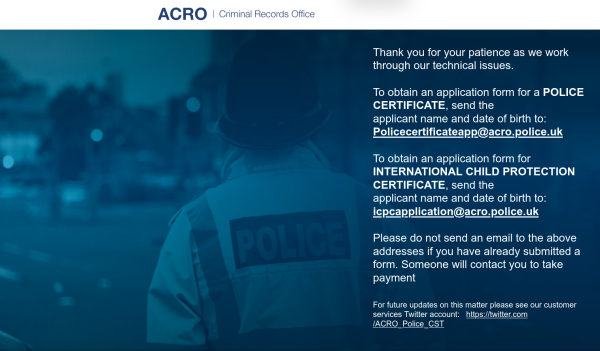
Today’s edition of The Register reports that ACRO, the UK’s Criminal Records Office was taken offline due to a security breach. The site currently displays a holding page blaming ‘technical issues‘, a fine example of misleading bureaucratic language.
This is the site’s holding page as this post is published.
El Reg notes that manages ACRO people’s criminal record information, running checks as needed on individuals for any convictions, cautions, or current prosecutions. It with British police and businesses, as well as exchanging this data with other countries, particularly where people wish to move or emigrate to another country and a certificate of good behaviour is required from the British police. ACRO has access to data from the Police National Computer via an information sharing agreement with the Cabinet Office.
The data typically handled by ARCO includes name and address history, extended family information, a new foreign address, legal representation, passport information, photo and data PIN cautions, reprimands, arrests, charges or convictions.
Earlier this week, ACRO emailed users to inform them that it had “recently been made aware of a cyber security incident affecting the website between 17th January 2023 and 21 March 2023“, adding that “we have no conclusive evidence that personal data has been affected by the cyber security incident; however it is only right that we inform you of the situation. We are very sorry that because of your interaction with ACRO your data could have been affected, and we are working tirelessly to resolve this matter.”

The message went on to say that “robust measures” had been taken as soon as the breach was discovered. It won’t be the first time that pulling the plug on a website has been described by a public sector organisation spokesperson as “robust”, If your systems were truly “robust”, taking the site offline would not have been necessary.
After intoning the “robust” mantra, ARCO then goes on to say: “We take data security very seriously and will ensure that the matter is fully investigated…. Translating this into plain English, this means “Oh dear! We’ve been caught out!”
The fact that ARCO had not taken data security “very seriously” is clearly highlighted by two facts:
The public sector relies heavily on public trust to do its work. If it really does want to be taken seriously, tough measures need to be taken and implemented, not just for IT security, but in connection a very ancient and fundamental idea: that of honesty.
The Twitter account of the British Government’s Home Office is normally a conduit for the worst ideas dreamt up by the alleged government’s most authoritarian and repressive ministry.
As such it tends to repeat and amplify the dog-whistle racism and xenophobia embodied in the hostile environment that has characterised its attitude to non-British people, particularly if they are not white, since the Home Secretary was one Theresa May, who later went on to do bad prime minister impressions in the Westminster Palace of Varieties.
The post of Home Secretary is currently occupied by one Sue-Ellen Cassiana “Suella” Braverman, a woman of no discernible talent other than being incompetent and nasty.
Braverman is currently on her second term of office as Home Secretary, having been initially appointed as such under the premiership of one Elizabeth Mary Truss on 6 September 2022. However, like her boss, Braverman did not last long in post, resigning because she had made an “honest mistake” (a likely story. Ed.) by sharing an official document from her personal email address with a colleague in Parliament, an action which breached the Ministerial Code.
On 25 October, Braverman was re-appointed as the home secretary by the prime minister Rishi Sunak, in direct contradiction of his promise of “integrity, professionalism and accountability”. Does someone who broke the Ministerial Code have any integrity or professionalism?
Since her re-appointment, has continued with hostile policies towards refugees and asylum seekers with a modern take on the reintroduction on the prison hulks of two centuries ago to house these people before they are deported to that shining beacon of human rights known as Rwanda.
Yesterday, the Home Office’s Twitter account finally admitted how dangerous the Home Secretary was, calling her “one of the greatest injustices in modern Britain” and calling for her end.
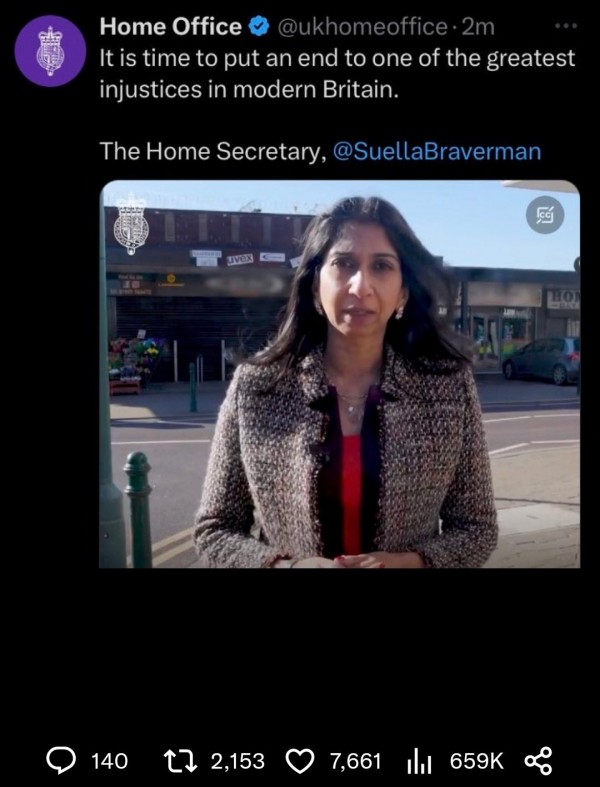
The post has since been deleted.
It has often been remarked that Britain and the USA are two countries divided by a common language.
However, let’s not forget that the spread of English around the world resulted in the development of different varieties of English around the world, all with varying degrees of (in)comprehensibility.
A prime example of something beyond the comprehension of your ‘umble scribe turned up this morning in his social media feed. It contains a fine example of some prime official gibberish from the state authorities of New South Wales in Australia.
If you, dear reader, can make any sense of it, please feel free to use the comment form below to provide a translation into British English; furthermore, please feel free to add any punctuation which you deem will aid comprehension as the original notice has none. 😀

 On Tuesday 9th March, the Administrative Court in Bastia overturned those articles of the rules of procedure of the Corsican Assembly and the Corsican Executive Council that provide for debates to be held in both Corsican and French, Corse Matin reports. The Court regards these provisions as infringing Article 2 of the French constitution, according to which “the language of the Republic is French“.
Former prefect of Corsica Pascal Lelarge, had lodged an appeal in this matter, requesting withdrawal of the decisions adopting these two rules of procedure, in view of the fact that references to the notion of the Corsican people and the Corsican language as a possible working language for the Corsican assembly, undermine to the French constitution.
This decision is tantamount to depriving the elected representatives of Corsica of the right to speak their language during debates within the Assembly of Corsica, the Executive Council of Corsica and acts of public life. Accepting this situation is unthinkable for us.
Even regardless of the appeal to be lodged against this judgement, this court decision and its reasoning only confirm the absolute necessity of a constitutional revision, in particular to guarantee the Corsican language the status of joint officiality, an essential condition for its survival and development.
With the rules of procedure of the Corsican Assembly having been adopted unanimously, at the next session we will propose that all groups adopt a common position in the face of the legal and political situation created by the judgment of the Administrative Court in Bastia, which is subject to an appeal.
The blog of The Document Foundation, the organisation behind the free and open source LibreOffice productivity suite, reports that the user guide for Base, the suite’s database development and administration tool for relational database management systems has now been translated into Czech.
Czech LibreOffice community member Zdeněk Crhonek (aka “raal”) writes as follows:
The Czech team translated the LibreOffice Base Guide 7.3 – and it’s now available on the documentation page. Our team consists of three translators: Petr Kuběj, Radomír Strnad and Zdeněk Crhonek, along with localized screenshot maker Roman Toman, and Miloš Šrámek, who prepared machine translations.

Learn more about or join the LibreOffice Documentation project.
The M4 motorway is the main road connection across the Severn estuary between England and South Wales.
Originally it crossed the river at Aust via the Severn Bridge/Pont Hafren, replacing an old ferry service .
After the completion of the Second Severn Crossing, the section of the M4 from Olveston in England to Magor/Magwyr in Wales was re-designated as the M48.
In an act of Whitehall arrogance, the Second Severn Crossing was later renamed the Prince of Wales Bridge with no public consultation, almost as if to prove that Wales is still England’s oldest colony.
Repairs are due to be carried out to potholes on the new bridge and this was duly reported on the Bristol (Evening) Post/Bristol Live website, as is also shown by the following screenshot.
![Headline reads M4 disruption for over 5 hours due to repair potholes [sic]](http://xislblogs.xtreamlab.net/slwoods/wp-content/uploads//sites/23/2023/03/post_severn_bridge.png)
A small problem occurs here. Knowledgeable readers will at once discern that the bridge used to illustrate the link from the site’s home page to the article is actually the 1960s Severn Bridge, not the Charles Philip Arthur George Mountbatten-Windsor Bridge. Has Reach plc also dispensed with picture editors as well as sub-editors in a dual bid to reduce both costs and the quality of its so-called ‘journalism‘,
Finally it is worth noting that this story does not appear on the Post’s Reach stable companion for South Wales, the Western Mail/Wales Online website (affectionately known as Tales Online. Ed.).
Thérèse Coffey, the alleged Secretary of State for Environment, Food and Rural Affairs, has advised consumers to opt for turnips as tomato and cucumber supplies dwindle, owing to shortages.
This instantly reminds your correspondent of that phrase attributed to Marie Antoinette, supposedly uttered by her during the French Revolution: “Qu’ils mangent de la brioche“, usually translated into English as “Let them eat cake“.
However, there is no there is absolutely no historical evidence that Marie-Antoinette ever said “Qu’ils mangent de la brioche” or anything like it, although folklore scholars have found similar tales in other parts of the world.

Anyway, back to Coffey, a minister devoid of humanity and compassion, but richly endowed with incompetence, callousness and that all-important can’t-do attitude.
Coffey has stated that shortages of salad and other vegetables in UK supermarkets could last up to a month. However, critics have accused the government of bringing the problem on itself by failing to support local growers and through Brexit policies.
Speaking in the House of Commons, Coffey told MPs British consumers should “cherish” home-grown produce, whilst castigating the latter for wanting “a year-round choice“.
In her own words:
“It’s important to make sure that we cherish the specialisms that we have in this country. A lot of people would be eating turnips right now rather than thinking necessarily about aspects of lettuce and tomatoes and similar.”
Finally, so that Coffey can indulge in ‘cherished‘ home-grown produce, your ‘umble scribe will perform a public duty by providing a link – should the alleged Secretary of State happen to be reading this post, to a recipe for cream of potato and turnip soup.
Enjoy! 😉
Update 25/02/23. One consequence of Ms Coffey’s advocacy of “cherishing” this humble root vegetable is that supermarkets are reported as running of turnips. Your correspondent could find none at his local Lidl yesterday, although swedes (the Swedish turnip) are plentiful.
As a final postscript, your ‘umble scribe notes from The Guardian today that its political sketch writer John Crace has written:
Four years ago I tweeted, “Let them eat turnips”. It was meant to be a joke about Brexit. Now it’s government policy. Satire comes at you fast these days.
One disadvantage of social media is it allows hard-of-thinking bigots a platform to express their prejudices.
However, this might not always work to the advantage of the prejudiced, as the exchange below between a Tennessee redneck and Customer Service for the Campbell Soup Company re homophobia illustrates.

According to Wikipedia, chicken soup – with or without noodles – ‘has long been touted as a form of folk medicine to treat symptoms of the common cold and related conditions. In 2000, scientists at the University of Nebraska Medical Center in Omaha studied the effect of chicken soup on the inflammatory response in vitro. They found that some components of the chicken soup inhibit neutrophil migration, which may have an anti-inflammatory effect that could hypothetically lead to temporary ease from symptoms of illness’.
No research has yet been conducted into the curative properties of chicken soup on prejudice and homophobia.
However, Campbells could be onto something. In the words of the French chef and culinary writer Auguste Escoffier:
Soup puts the heart at ease, calms down the violence of hunger, eliminates the tension of the day, and awakens and refines the appetite.
Bon appétit, bigot! 😀
An apposite quotation from Once in a Lifetime</em> off Talking Heads’ 1980 album Remain in Light captions this image which has now turned up twice this week in my Mastodon social media feed.