politics

  • Greens take impressive lead in recycling box poll

    It’s one week to go to the elections for Bristol City Council, the elected Mayor of Bristol (with 2 of the 9 candidates standing for election to the office vowing to hold a referendum with a view to abolishing the autocratic post. Ed.), the West of England Combined Authority Mayor and the Avon & Somerset Police & Crime Commissioner.

    My recycling box is rapidly filling up with election materials as the parties all vie for my cross against their candidates’ names on the four ballot papers (Hint to canvassers: don’t bother with my house any more; I’ve already voted by post! Ed.).

    Following the arrival on the latest leaflet on the doormat, the poll has been updated and now shows the following state of the parties.
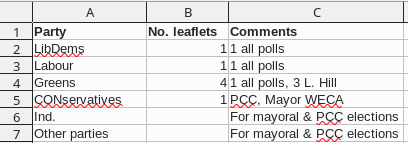
    Screenshot of spreadsheet showing Greens with 4 leaflets and other parties with 1 each

    The Greens seem determined to win Lawrence Hill ward and are pulling out all the stops. As they’re normally in fourth place, the Tories have managed on token leaflet as have the Liberal Democrats, who were once renowned for their zeal in bunging up letterboxes with their literature.

    Why has there only been one Labour leaflet? Is this a symptom of lower levels of activism in the wake of members deserting the party after the election of Keir Starmer (whom some unkindly refer to as Keith. Ed.)?

    All will become clear next week.

    Maybe.

  • German federal elections 2021 – Demands for digitally sovereign society

    FSFE logoGerman digital civil society organisations have made four demands for a digitally sovereign society to politicians standing in the 2021 federal election in late September 2021. Among them is the Free Software Foundation Europe (FSFE), which works to ensure that software developed with public money shall be published under a free and open source software licence.


    On 1st April 2020, German civil society organisations working for an independent digital infrastructure and free access to knowledge called on politicians to learn from the crisis and strengthen digital civil society.

    In an open letter (German) of that date, the signatories (Chaos Computer Club, D64 – Zentrum für Digitalen Fortschritt, Epicenter.Works, the FSFE, Stiftung Neue Verantwortung, Superrr Lab and Wikimedia Deutschland) also made clear recommendations for action. However, far too little has happened since then. The past year has made it clear that politics and the public sector are overwhelmed with their own digital transformation and are setting priorities in digital policy that do not meet the needs of society. We are far from a digitally sovereign society.That is why a broad spectrum of organisations, including the FSFE has once again come together to support politics with their expertise.

    With four demands, the network shows how digitisation can succeed for a digitally sovereign society – and calls upon the parties to make digitisation for the common good a central topic in the forthcoming federal elections.

    Reichstag and projected Give Free Software a chance message
    Photo courtesy of FSFE
    Four demands for the federal government
    • Digital Sovereignty: politicians must anchor the digital sovereignty of society as the highest maxim in digital policy. Instead of a digital ministry, we need a mission for the coming legislative period that elevates digital sovereignty to a guiding principle and is drafted and evaluated together with representatives from civil society, science and business.
    • Participation and Transparency: civil society must finally be afforded the same opportunities as business and science to contribute its expertise via a civil society quota in political advisory bodies, communication and transparency on procedures of political decision-making processes, legally defined deadlines for consultations and machine-readable documentation.
    • Public Money, Public Good: publicly funded solutions must be accessible to all under a free licence so that no knowledge is lost or problems are solved twice. It should be a legal requirement that software developed for the public sector with public money must be published under a free and open source software licence. If public money is involved, the code should also be public. In addition, public sector data must be open data.
    • Sustainable Digitisation: digitisation can only succeed if the development of digital infrastructure is economically and socially viable. To this end, diversity in digitisation and the development and maintenance of secure, decentralised digital infrastructure for society must be promoted in the long term.
    5th May launch event

    A new organisation and website – https://digitalezivilgesellschaft.org/ – has been established to promote the above demands and a launch event will be held on 5th May 2021 from 18:00 to 19:30 hrs to discuss these demands with a panel consisting of Julia Reda (former MEP), Henning Tillmann (software developer and co-chair of D64) and Julia Kloiber (co-founder Superrr Lab). The panel will be moderated by Katja Jäger (betterplace lab). Afterwards, all participants will have the opportunity to exchange ideas on solutions, measures and calls for action in four thematic rooms. FSFE’s Alexander Sander will moderate the room on “Public Money? Public Code!”.

  • Alleged Prime Minister pwned

    Yesterday, which was Earth Day, US President Joe Biden organised a two-day virtual climate summit bringing together dozens of world leaders.

    Apart from world political leaders, Biden also inexplicably invited one Alexander Boris de Pfeffel Johnson, Britain’s part-time alleged Prime Minister, to participate.

    Besides his propensity never to let the truth escape from his lips, Johnson is well known for his lack of attention to detail, his loose tongue and gaffes; and true to form he didn’t fail to embarrass the country of which he is supposed to be the highest elected public official, as shown in the following video clip.


    Yes, you did hear that correctly – “politically correct green act of bunny hugging“!

    Needless to say, Bozo the Clown had half of the country’s social media users rolling their eyes in despair, condemning his cavalier attitude and wondering what the blonde buffoon was going to sully next with his reverse Midas Touch.

    However, it wasn’t just Britons who reacted to Bozo’s gaffe.

    Amongst them was one Greta Thunberg, an 18 year-old Swede whose name is not exactly unknown on the world stage where climate change is concerned.

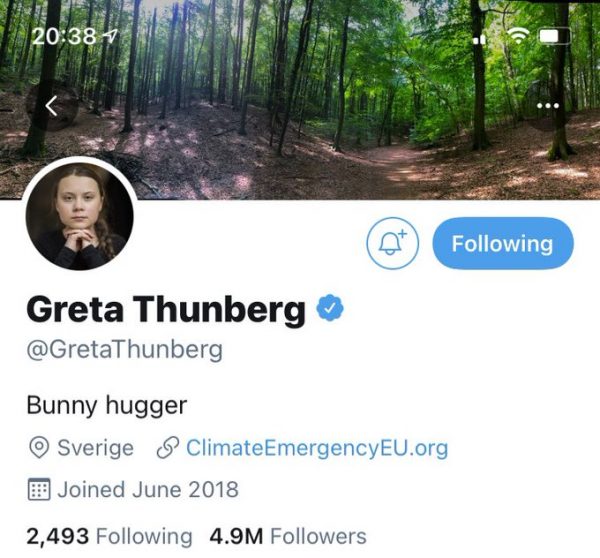
    Greta very quickly changed her Twitter bio to reflect Johnson’s words.

    Screenshot of Greta Thunberg's Twitter bio, which now reads Bunny Hugger

    Nice work, Greta! 😀

    As for the embarrassment that is part-time alleged Prime Minister Alexander Boris de Pfeffel Johnson, you can consider yourself well and truly pwned.

    Friday afternoon update: the Green Party has now joined in the general mockery of Johnson’s remarks.

    Tweet reads: To do list: Heavy check mark  Make lunch Heavy check mark  Hug bunnies Heavy check mark  Join the Green Party

  • Local elections 2021 – the recycling poll

    It’s getting close to election time again and the period of what is informally known as “purdah” (also known rather more formally and stuffily in local authority circles as the “pre-election period” Ed.), which has very little to with purdah’s original definition, i.e. a religious and social practice of female seclusion prevalent among some Muslim and Hindu communities, and more to do with preventing central and local government from making announcements about any new or controversial initiatives that could be seen to be advantageous to any candidates or parties in the forthcoming election.

    Here in the Bristol area, elections are being held not only for the local council, but also for the elected Mayor of Bristol, the Avon & Somerset Police and Crime Commissioner and the Mayor of the West of England Combined Authority (WECA).

    As is usual with matters electoral, I keep a record on a LibreOffice spreadsheet of all election leaflets received, which ultimately end up in their rightful place – the waste paper recycling box (apart from personally addressed material, which is fed to the confidential waste shredder. Ed.).

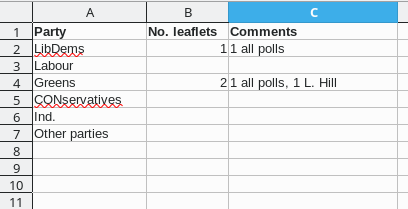
    The latest state of the parties – as of first thing this morning – is shown below.

    Screenshot of election leaflet spreadsheet

    As can be seen, the Greens are clearly putting a major effort into depriving Labour of their 2 ward seats for Lawrence Hill in the council chamber.

    Whilst elections may be regarded as a vehicle of change, there are certain features that are reassuringly familiar and are thus recycled election after election.

    For instance, the first leaflet received after the notices of persons nominated were announced was one from the Liberal Democrats, as per their decades-long reputation for opportunism.

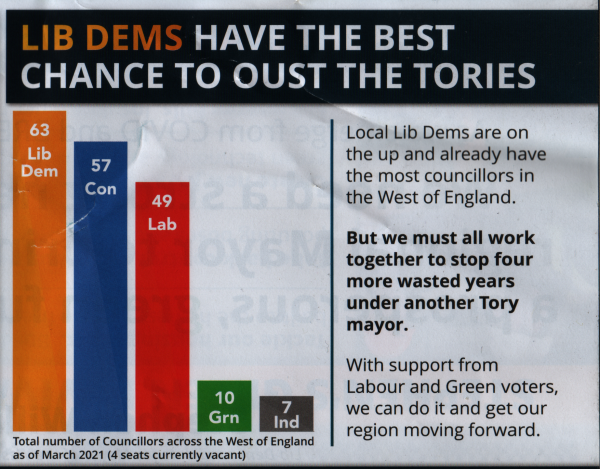
    That leaflet also comprised other reassuringly familiar Liberal Democrat tropes, such as the bar chart below for the WECA Mayor. I am reliably informed by a fellow linguist who took a ruler to the y axis, that the column sizes are reasonably accurate (for once. Ed.)

    Bar chart scanned from LibDem election leaflet

    That just leaves the equine graphic with the heading “It’s a 2 horse race! (Insert_party_name) can’t win here!” and the traditional graphics requirements for LibDem leaflets will have been fulfilled.

    More leaflets can of course be expected to land on the doormat as polling day approaches, so updates will be provided in due course.

  • A Scots terminology question

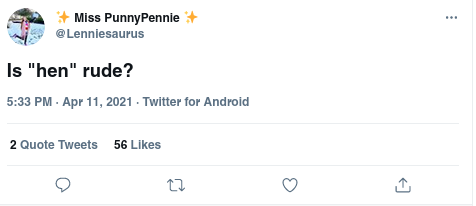
    One Twitter account I follow is Miss PunnyMany for her insights into Scots English. She’s just asked a very important question of manners and terminology in this tweet, as shown below.

    Tweet reads Is hen rude?

    Well, is “hen” rude?

    Let us see.

    An accurate definition would be a good place to start.

    A general glossary of Scots vocabulary posted on Stirling University’s website provides the following definition:

    hen: vocative term for a woman (e.g. ‘It’s aw richt, hen’), or a general term of endearment for anyone.

    Note the phrase “general term of endearment“. That’s a big clue, indicating that its use is confined to close friends and acquaintances.

    This view is largely borne out by the tone of the responses to Miss PunnyMany’s tweet.

    Furthermore, a few respondents rightly point out that, like “pal” south of the Border, “hen” may be used in a pejorative or threatening manner to people outside one’s immediate social circle.

    Mhairi Black MP
    You don’t talk shite, hen!

    An example of this can be found in a place a fair way from Scotland, namely the chamber of the House of Commons in Westminster.

    Back in March 2017, SNP Member of Parliament Mhairi Black gave rise to comment in the media and on social media when appearing to mouth the words “You talk shite, hen” to a response by Tory minister Caroline Nokes, then the Under Secretary of State in the Department for Work and Pensions.

    Ms Black had just made an impassioned speech that criticised a Government proposal to withdraw housing benefits for 18-21-year-olds. Her silent, but lip-read comment denoting her clear displeasure came during Ms Nokes’ reply which naturally defended the government’s cruel proposal.

    So there you have it, use “hen” sensibly and restrict it to family, close friends and acquaintances, you shouldn’t go too wrong.

  • Shabby? Not me, says PM

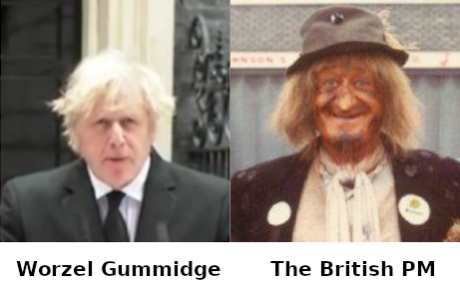
    Worzel Gummidge, the British Prime Minister, has responded to criticism in the press regarding his “shabby” and “disrespectful” appearance, and that he “couldn’t even do his hair” when making a statement in Downing Street about the death on Friday of Philip Mountbatten-Windsor, aged 99.

    Lookalikes - Boris Johnson and Worzel Gummidge
    Mirror, mirror on the wall, who’s the scruffiest of them all?

    Speaking from Chequers, a visibly shocked an astounded Worzel Gummidge apologised to those who had expressed their anger on social media and added: “Anyone would think I always looked as if I’d been dragged through a hedge backwards, like former London Mayor Alexander Boris de Pfeffel Johnson!”

  • Abroad thoughts from home

    One fascinating aspect of the country’s foolhardy departure from the European Union is the fate of Britons in the 27 member states of the European Union; and more particularly how they are depicted here now that the “free and independent coastal state” of Brexitannia has “taken back control“.

    Keen observers of the British media will note all foreigners seeking to come to the English Empire (which some refer to as the United Kingdom. Ed.) to settle are referred to as “migrants“. When used by the right-wing press or politicians, “migrants” has a clear pejorative tone to the effect that these people are not as good as us.

    However, in line with British exceptionalism as Brits seeking to or having taken up residence abroad are termed “expats” by the fourth estate, as per this typical specimen from yesterday’s Daily Brexit, which some still call Daily Express.

    Headline reads Brexit BACKLASH: British expats could abandon Canary Islands for Greece and Cyprus
    Expats? Emigrés? Immigrants?


    Of course, what the Daily Brexit forgets is that even in Greece and Cyprus, holders of those nice, new and allegedly blue British passports will still be classed as third country citizens by the Greek and Cypriot authorities; and if they try staying there for longer than the maximum period without applying for a residence permit, they’ll be regarded as illegal immigrants, just as they are now finding out on the Costa del Sol.

    Expat” is of course a truncation of the term “expatriate“, with the shorter form’s first recorded use in the first half of the 1960s.

    When people move for work, settlement or other reasons, the language used about them is always full of meaning. In earlier, less judgemental times those who left British shores to settle abroad might have been referred to as “émigrés” or “emigrants“, whilst those coming here for permanent settlement were “immigrants“, which had more than its fair share of negative connotations in times past.

    Nowadays all those negative connotations are to a certain effect by “migrant“, which, unlike “immigrant” or “emigrant” is not specific about the person’s direction of travel.

    Nevertheless, I can see the exceptionalism continuing and am not expecting the Daily Brexit to refer to Brits resident abroad as “British immigrants” at any time soon. 😉

    PS: Apologies to Robert Browning for this post’s title.

  • Dortmund adopts free software policy

    Phoenixsee, Dortmund. Image courtesy of Wikimedia CommonsDortmund’s city council has paved the way for “Public Money? Public Code!” In the future, software developed or commissioned by the administration will be made available to the general public, the Free Software Federation Europe (FSFE) reports.

    Back in February, the city council approved a motion previously submitted by the SPD, Bündnis90/Die Grünen, CDU, Die Linke+ and FDP/Bürgerliste. In the future, Free Software is to be used wherever possible and software developed or commissioned for development by the administration is to be made available to the general public.

    Matthias Kirschner, President of the Free Software Foundation Europe states: “We are happy that the DO-FOSS initiative was able to convince the city of Dortmund of the principle of “Public Money? Public Code”. Free Software gives everyone the right to use, study, share and improve software for any purpose. These freedoms also benefit administrations. Public administrations that follow this principle can benefit from numerous advantages: Collaboration with other government agencies, independence from individual vendors, potential tax savings, innovation and a more solid basis for IT security. The Council’s decision means that there is now the political backing to gradually break down dependencies on proprietary vendors. We will accompany the implementation and at the same time call on other administrations in Germany and Europe to follow Dortmund’s example.

  • New alternative to binning soft plastic

    Tesco logoThe BBC reports that Tesco is to introduce collection points for soft plastic packaging such as crisp packets, pet food pouches and bread bags at its stores in England and Wales.

    This follows a successful trial in 2018 at 10 stores.

    The roll-out will start with facilities being installed in 171 stores in south-west England and Wales.

    Tesco is hoping to collect 1,000 tonnes of soft plastic a year and customers may return packaging from other retailers as well as its own packaging provided all packaging presented for collection is clean.

    Soft plastic is notoriously hard to recycle and most currently ends up going to landfill or being incinerated.

    Given Bristol’s wide range recycling collections, this type of plastic makes up the majority of my residual waste collected by the refuse lorry.

    With this move, Tesco is finally living up to its “Every little helps” motto.

Posts navigation