Steve Woods

Written by a human.

  • Election special: language Luddites ban purdah

    On 5th May elections will be held in England for local councils, local police and crime commissioners and in Bristol the elected Mayor.

    As part of the election process, there’s a period before the announcement of the election and the final election results in which central – in the case of general elections – and local government is prevented from making announcements about any new or controversial government initiatives (such as modernisation initiatives or administrative and legislative changes) which could be seen to be advantageous to any candidates or parties in the forthcoming election.

    This period has traditionally been called “purdah” after the practice in certain Muslim and Hindu societies of screening women from men or strangers, especially by means of a curtain. “Purdah” itself originates from Urdu and Persian “parda“, meaning a “veil” or “curtain“.

    Bristol City Council logo with sinking shipEarlier this month I attended the quarterly meeting of Bristol’s Ashley, Easton & Lawrence Hill Neighbourhood Partnership. At this meeting attendees were clearly told by the officer serving the partnership that “purdah” was no longer an acceptable term and that the time in question should be referred to as the “pre-election period“.

    This occurred after “purdah” had already been used a few times by elected councillors and makes your correspondent wonder if colourless, unaccountable, unelected council officers (whose wages we pay. Ed.) should be allowed to dictate the vocabulary which is used in meetings.

    I don’t think they should.

    Do you agree or disagree with my conclusion? Please comment below.

  • A salacious street name

    Last Thursday I was in Shrewsbury, county town of the county of my birth. Shrewsbury is steeped in a wealth of medieval history, including plenty of ancient street names (mostly based upon the shops sited there – e.g. Butcher Rown, Fish Street, etc. Ed.), amongst them the intriguingly titled Grope Lane.

    Grope Lane sign
    Grope Lane street sign
    A look back down Grope Lane towards High Street
    A look back down Grope Lane towards High Street

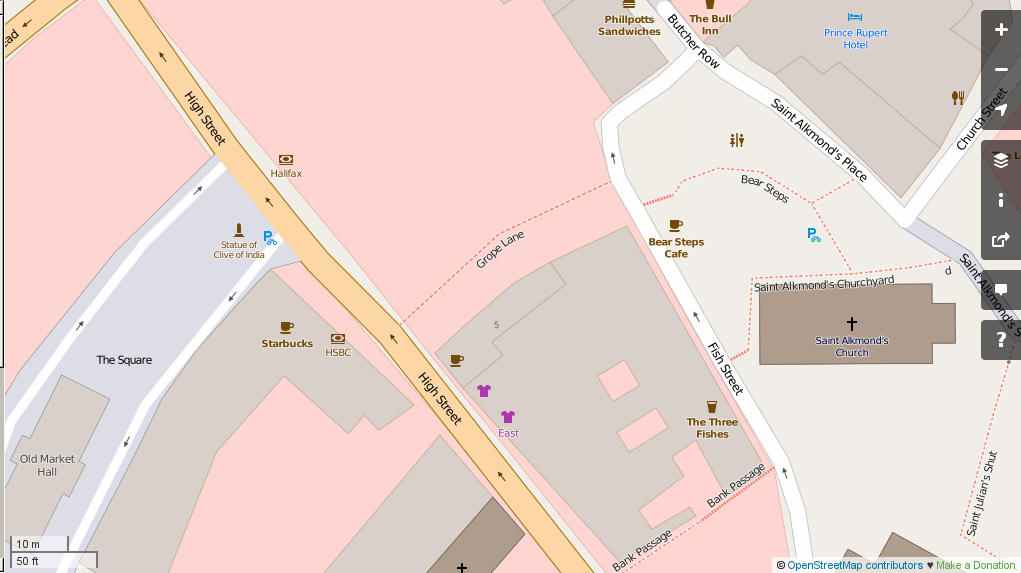
    Grope Lane in Shrewsbury is a narrow alley connecting High Street and Fish Street in the heart of the old medieval town, as shown on the location map below.

    Location of Grope Lane in Shrewsbury
    Location of Grope Lane in Shrewsbury. Image courtesy of OpenStreetMap. Click on image for full-sized version

    As with many towns in the Middle Ages, Shrewsbury’s Fish Street (and nearby Butcher Row. Ed.) are named after the trades that occupied them. However, Grope Lane is also reputed to be linked to trade – this time the pleasures of the flesh.

    Wikipedia has an excellent page on this street name in its unsanitised version.

    Gropec*nt Lane, says Wikipedia, was a street name found in English towns and cities during the Middle Ages, believed to be a reference to the prostitution centred on those areas… Gropec*nt, the earliest known use of which is in about 1230, appears to have been derived as a compound of the words grope and c*nt (our medieval forebears were less sensitive and more earthy in their use of language than their modern descendants, as anyone who had read Chaucer in the original Middle English can testify. Ed.). Streets with that name were often in the busiest parts of medieval towns and cities.

    Towns and cities with active quays or ports often had an adjacent Grope(c*nt) Lane, as in the case of Bristol, although that street name recorded in the reign of Edward III (1312-1377), was subsequently changed to Hauliers Lane and has since been changed again (see below).

    Although the name was once common throughout England, changes in attitude resulted in its replacement by more innocuous versions such as Grape Lane. A variation of Gropec*nt was last recorded as a street name in 1561.

    In Shrewsbury a street called Grope Countelane existed as recently as 1561 and connected the town’s two principal marketplaces. At some unspecified date the street was renamed Grope Lane, which it has retained to the present day. In Thomas Phillips’ History and Antiquities of Shrewsbury (1799) the author is explicit in his understanding of the origin of the name as a place of “scandalous lewdness and venery”, but Archdeacon Hugh Owen’s Some account of the ancient and present state of Shrewsbury (1808) describes it as “called Grope, or the Dark Lane”. As a result of these differing accounts, some local tour guides attribute the name to “feeling one’s way along a dark and narrow thoroughfare”.

    Other towns and cities in England also had their own local Grope(c*nt) Lane including the following:

    • London (several examples);
    • Bristol (now called Nelson Street);
    • York;
    • Newcastle upon Tyne;
    • Worcester;
    • Hereford;
    • Oxford (now Magpie Lane);
    • Norwich (now Opie Street);
    • Banbury (now Parsons Street);
    • Glastonbury (now St Benedicts Court); and
    • Wells (initially changed to Grove Lane, now Union Street).
  • LibreOffice 5.1.1 released

    Three days ago, The Document Foundation (TDF) announced the release of LibreOffice 5.1.1, the latest release of the LibreOffice 5.1 family.

    LibreOffice 5.1.1 offers a long awaited feature in Writer – the first request for which dates back to 2002 – as it allows hiding the white space between pages to provide a continuous flow of text. This feature will be extremely useful on laptops.

    LibreOffice 5.1.1 is targeted at technology enthusiasts, early adopters and power users. For more conservative users and enterprise deployments, TDF suggests the “still” version: LibreOffice 5.0.5. For enterprise deployments, The Document Foundation recommends engaging certified professional support.

    People interested in technical details about the release can see the bugs fixed in Release Candidate 1 and RC3. There was no intervening RC2.

    LibreOffice 5 series screenshot
    LibreOffice 5 series screenshot

    Download LibreOffice

    LibreOffice 5.1.1 is immediately available for download.

    Besides the “fresh” and “still” versions of LibreOffice, those who want to be at the bleeding edge or assist in development can also download development versions, nightly builds and the source code. Your correspondent is currently using a pre-release version, 5.1.3*.

    Finally LibreOffice users, free software advocates and community members can support The Document Foundation with a donation.

    * = When initially upgraded, the installation process reported data corruption in the Calc spreadsheet component. This was resolved by downloading the package again and re-installing the relevant spreadsheet packages.

  • Another missing court interpreter

    Court cases around the country are still being delayed for want of interpreters who are supposed to be supplied by arch outsourcers Capita.

    Today’s Sentinel reports on a case that was adjourned yesterday at North Staffordshire Justice Centre in Newcastle-under-Lyme.

    Maris Dombovskis of Longton is charged with failing to provide a specimen of breath for analysis, driving without insurance and without a licence on January 19.

    District Judge Jack McGarva adjourned the case until February 29 to arrange for an interpreter.

    This was the second time last week that a court case at this court complex had to be adjourned for lack of an interpreter.

    On Tuesday 23rd February magistrates adjourned the case of a Polish resident of Smallthorne charged with assault for 3 days to arrange for an interpreter, The Sentinel also reported.

  • Recommended LibreOffice extension – Portrait or Landscape

    One of the great advantages of using the free and open source LibreOffice productivity suite is the existence of extensions that extend the suite’s functionality.

    Those extensions that save me either time or effort or both are particularly welcome. The last extension recommended on this blog was the MultiFormatSave extension, which enables saving in up to 3 separate file formats (ODF, MS Office and PDF) with one mouse click.

    Today another extension has come to light which likewise saves your correspondent time and effort – Portrait or Landscape, developed by Antonio Faccioli.

    In my work documents are quite frequently submitted for translation with page orientations that switch back and forth between portrait and landscape or vice versa. In the past, coping with these changes has necessitated consulting LibreOffice’s help files, followed by implementing what I’ve just read, all of which takes a couple of minutes and involves burrowing down through the Format menu, as the procedure isn’t as straightforward as it could be.

    Once installed, Antonio’s new extension inserts a toolbar with 5 new icons, as shown below on the left of the image below. These new icons make changing page orientation a very simple operation involving a single click of the mouse.

    LibreOffice menu with Portrait or Landscape extension installed on the left
    LibreOffice menu with Portrait or Landscape extension installed on the left

    The extension uses the styles “Default”, “Landscape” and “First page” to change the orientation of the current page or to insert a new page. It also displays a message showing the style currently in use.

    The extension has been tested on LibreOffice 5.0 and is licensed under version 3 of LGPL.

    Thank you very much for this extension, Antonio; you’ve one very happy user of your extension here! 🙂

  • The Document Foundation is 4 today

    Today The Document Foundation, the independent self-governing meritocratic body created by former leading members of the OpenOffice.org Community to continue developing a free and open source office suite – LibreOffice – celebrates the 4th anniversary of its incorporation as a charitable Foundation under German law (gemeinnützige rechtsfähige Stiftung des bürgerlichen Rechts).

    To mark this milestone, the Foundation has released the video below to illustrate the breadth of the LibreOffice community today.

    Happy birthday, The Document Foundation!

  • Vicious toilet

    Beware if you ever visit the gents at the Bull Hotel at Fairford in Gloucestershire; the vitreous china might attack you.

    Last Friday’s Wilts & Gloucestershire Standard reports that a customer who smashed the toilet to bits claims he was acting in self defence.

    toilet
    Wot you lookin’ at? Wanna fight?

    The unnamed Kempsford man claims he was about to be attacked and smashed the toilet to attract the attention of other patrons.

    However, the local constabulary were unimpressed by his assertions and he’s due to appear before Cheltenham Magistrates on 24th February.

    Hat tip: Dr Bob Irving.

  • Bristol to increase fly-tipping enforcement

    Yesterday Bristol City Council set its budget for the next financial year.

    While the Bristol Post’s report concentrated on the 4% increase in council tax and Bristol’s donation of £500,000 for a Concorde museum in neighbouring South Gloucestershire, its political editor, Ian Onions, somehow managed to omit some important news for those fighting environmental crime in the city.

    This news was that the city council will be employing two more so-called “streetscene” enforcement officers next year, bringing the total number of these officers employed by the city council to 8. These officers are responsible for bringing fly-tippers and litter louts to book.

    photo of Marg HickmanLawrence Hill ward councillor Marg Hickman conveyed this news to Tidy BS5 campaigners yesterday evening, stating that the Labour group’s amendment calling for the 2 additional officers was the only amendment to the Mayor’s budget to receive 100% support in the council chamber.

    Marg was one of 2 councillors to speak to the amendment (another colleague spoke on dog fouling, another of the blights of urban life, in support of the amendment. Ed.). Her speech is transcribed below and conveys many of the sentiments that Tidy BS5 campaigners have been voicing to the council for the past 2 years, with the local authority’s lack of action to date neatly summarised by the phrase “glacial speed of change“, although your correspondent reckons that glaciers actually move faster than Bristol City Council and a more accurate comparison would be with tectonic plates.

    Institutional neglect has been the impact of Green Capital on parts of the city. What is certain is that, when it comes to the cleanliness of most areas of the city, this much-praised initiative has had minimal effect.

    In 2013/14 Bristol had the unenviable status of the dirtiest place in the South West. According to government statistics, Bristol residents reported 10,472 incidents of fly-tipping – can you imagine how many more unreported incidents there must have been? It was with this statistic as a backdrop that the number of street scene enforcement officers was cut in 2013 from 10 officers, plus support staff and 3 dog wardens, to approximately 6 today. In comparison I can reveal that during our Green Capital year we had an army of PR experts – 45 in total – all employed to make the council look good. Well, I know, and I am sure many of you would agree, that our residents would prefer it if we employed more people to keep our communities looking good rather than ourselves.

    There seems to me to be complacency in the council regarding the unacceptable levels of fly-tipping and litter in areas from Lawrence Hill and Eastville to Lawrence Weston, and it is compounded in the south of the city by the Mayor’s refusal to sign off the waste recycling centre in Hartcliffe.

    In BS5, one of the city’s fly-tipping hotspots, which stretches from across the road from Cabot Circus to Eastville, there have been 32 enforcement actions taken against people. This low level of enforcement is because of the cuts and the lack of ongoing training and development of the enforcement staff. We need to augment our street enforcement officers and provide proper support and training, and learn from best practice from around the country to deal with the issue of waste at a time of shrinking budgets.

    We have to support communities across Bristol blighted by this environmental eyesore and come up with solutions that work. We need to consult affected communities, speed up the glacial speed of change, and increase the number of properly trained and supported enforcement officers.

    We have before us an amendment that will get the ball rolling and help kick-start the change we need to clean up our streets. Surely money would be better spent on this rather promoting more and more PR people.

    We would all benefit from this amendment. The communities you serve would benefit and Bristol as a whole would be a cleaner and happier city. Please support this amendment today so that Bristol can be the cleanest city in the South West and not the dirtiest.

  • LibreOffice 5.0.5 released

    Yesterday The Document Foundation announced the release of LibreOffice 5.0.5, the fifth release of the LibreOffice 5.0 family. Following the release last week of LibreOffice 5.1 (posts passim), LibreOffice 5.0.5 becomes the latest in the “still” series of releases; the “still” series is a stable version that has undergone more testing over a lengthy and is recommended for deployment in large organisations.

    LibreOffice 5 splash screen

    Download LibreOffice

    LibreOffice 5.0.5 is available for immediate download at http://www.libreoffice.org/download/libreoffice-still/.

    Those interested in the release’s technical details can consult the change logs for both the RC1 bug fixes and RC2 bug fixes.

    Professional support

    The Document Foundation suggests large scale deployments of LibreOffice 5.0.5 are undertaken only with the backing of professional level 3 support from certified developers, for which the LibreOffice website has a list.

    Furthermore, when migrating to LibreOffice from proprietary office suites, organisations should seek professional support from certified migration consultants and trainers, which are listed on the same LibreOffice professional support web page.

    Supporting LibreOffice

    LibreOffice users, free software advocates and community members can support The Document Foundation by making a donation.

    In addition, supporters can also buy LibreOffice merchandise from the brand new project shop.

  • Love free software on Valentine’s Day

    It’s 14th February, better known to the world as St. Valentine’s Day. It’s therefore also time to say “thank you” to all free software users and developers on what’s also become the “I love FreeSoftware Day“, according to the Free Software Foundation Europe (FSFE).

    I Love Free Software banner

    The FSFE is asking all free software users to use the traditional day of love to think of the hard-working people contributing to the free software we all depend on.

    Free software drives a huge number of devices in our everyday life. It ensures our freedom, our security, civil rights, and privacy. It enables everyone to participate in a fair society. However, everyone is different and people have different reasons to love free software.

    Your ‘umble scribe relies on free software to play an active part in society and do his work. He’d therefore like to pay thanks to the following people:

    If you use free software too, why don’t you support this annual campaign, which can be followed on social media with the #ilovefs hashtag.

Posts navigation